Authors: Indrawan Prabaharyaka (Labtek Apung), Irina Rafliana (University of Bonn and BRIN Indonesia) and Casper Bruun Jensen (Independent)
Editor: Auriane van der Vaeren (4S Backchannels)
Following an invitation to reflect on the possibilities and challenges of Southeast Asian STS, this contribution is based on a WhatsApp conversation between Indrawan Prabaharyaka, Irina Rafliana and Casper Bruun Jensen. Irina and Indra met around 2021 while doing doctoral degrees in Germany on Indonesian tsunami warning systems and sanitation infrastructures. A prolific writer at the intersection of STS and anthropology, Casper has been living in Southeast Asia since 2012. His recent projects include “Entangled Areas: Reactivating Southeast Asia in the Anthropocene” (Jensen and Thufail 2025), “The Challenge of Southeast Asian Cosmopolitics” (Jensen forthcoming) and “Southern Anthropocenes” (Jensen 2025).
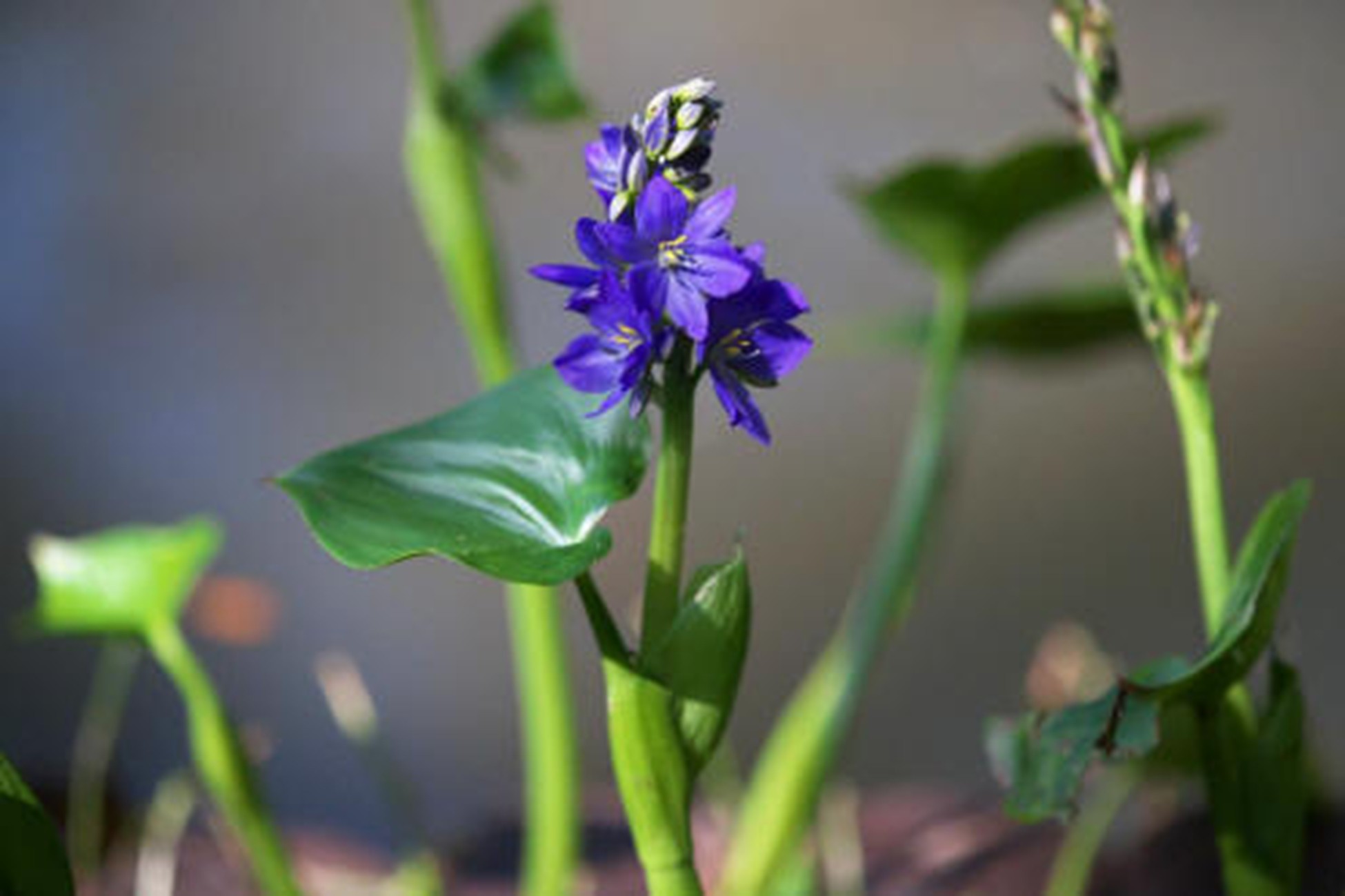
The Monochoria Korsakowii (Eceng gondok in Bahasa Indonesia, or Mizuaoi in Japanese) (credits). This almost extinct plant grows after the passing of the 2011 tsunami, allowing one to understand tsunamis as more-than-just destructive.
Casper Bruun Jensen: Indra, perhaps you can say a few words about how you became involved with STS? Indrawan Prabaharyaka: I would have loved to study philosophy for my bachelor’s degree, but my father scared me with, so I studied engineering at Institut Teknologi Bandung (ITB) (the oldest technical university in Indonesia) but read philosophy nevertheless: Foucault in Indonesian since my teenage years, and in 2010 I hung out with a Malaysian architect who studied at Columbia University and introduced me to Deleuze and Guattari. Irina Rafliana: Honestly, what was your experience with ITB? Indrawan: I feel ambivalent. The institute gave me good technical training and valuable connections with many scientists and bureaucrats. But I also feel resentful, because it is a stiff institute, whose graduates have built as well as destroyed multiple things in Indonesia. Casper: So what did you do after graduating? Indrawan: I worked in an NGO in Jakarta, lived in Mumbai, did a master’s degree in Johannesburg, and worked under the Indonesian Ministry of Planning. In 2015, I moved to Germany to do a doctoral thesis with Ignacio Farías at Technical University Munich (TUM). This was a time of many exciting discussions on STS, anthropology and philosophy. I moved to Humboldt University of Berlin in 2018, after Ignacio became a professor in urban anthropology and ended up studying the making of a laboratory as part of the construction of Jakarta’s sewerage system. I became friends with the laboratory supervisor, Novita, and we co-founded the Labtek Apung (Floating Laboratory) which addresses Jakarta’s water problems while exploring what an urban laboratory working with diverse forms of arts and research can be. Irina: I wasn’t observing the STS space in Indonesia before leaving for my doctoral studies in Germany around 2019. I got some exposure to these ideas from Fadjar Ibnu Thufail at the Indonesian Institute of Sciences (then LIPI, now merged into the National Agency for Research and Innovatio, BRIN). Fadjar shared his experiences with different styles of STS in the UK, the US and Germany, and remarked that STS is viewed as much more eccentric in Indonesia. Casper, if you remember, you introduced me virtually to Indra, and he walked me through the world of STS. Compared with the human-centric arguments about warning system technologies, the attention to the diverse agencies of the nonhumans, and notions of assemblages in warning systems through STS fascinated me. In the end, the title of my thesis — Traveling Waves of Knowledge and Technology: The Indonesian Tsunami Warning System — did not change (Rafliana 2025). But how I navigated the thesis after meeting you changed so significantly.
I went back to Indonesia during Covid in 2022, worrying about methods and the challenges of doing fieldwork at the National Agency for Meteorology, Climatology, and Geophysics (BMKG) during the pandemic. I remembered Indra’s words, which kept pushing me: ‘it’s interesting! — why not experiment with this or do that!’ I want to mention that although STS is not really known in Indonesia, I have not felt resentment or resistance from Indonesian protagonists, or interlocutors. It’s not been so difficult to access people or develop conversations. For example, BMKG (the authority for the Indonesian Tsunami Warning System) was very open, and even invited me to share my ethnographic observations to the entire staff — around 600 people.
Towards the end of my PhD, I joined Fadjar’s research centre at BRIN. With him as director, it seemed that STS would have a comfortable place and I might have a home. Indrawan: Thanks Irina! I feel (y)our experiences of STS are quite similar. STS feels comfy, informal and personal, based on word of mouth (“mulut ke mulut” in Indonesian). Casper: It seems that “mulut ke mulut” is involved in both of your trajectories, and it also resonates with my contingent experiences of meeting Jakkrit Sangkhamanee in Bangkok through Atsuro Morita in Osaka (via Gergely Mohácsi then at Keio in Tokyo and Anders Blok in Copenhagen) — and later getting in touch with Fadjar via Joshua Barker at the University of Toronto. So this kind of personalized transmission and translation of “interests,” “appreciations,” and “fascinations” is easy to understand. But things are quite different at the institutional level. Indrawan: In my view, one of the most challenging things in doing STS in Indonesia, if not Southeast Asia, has something to do with, let’s say, tradition. Traditionally, like in the US and Germany, STS works are hosted in technical universities (e.g. MIT, TUM), which have departments of philosophy, history, and social sciences. But even major Indonesian technical universities have no such departments. Irina: On the other hand, I find that these contexts make it easier or more convenient to dive into the rich and diverse meanings and roles of things/nature/spirits in Indonesia. Some geologists or engineers, musicians and artists already talk about ‘STS’ but not in structured or academic ways. So in a way it is there. Question: should STS thinking in Southeast Asia (SEA) be (re)structured? Would having a formal structure amplify STS studies in SEA? Indrawan: True. Next to these questions there is a lingering defeatism on science and technology in Indonesia, as if we’re at the end of the world without a future. If our science and technology is already inferior, why would we need (or want) anyone to study it? Casper: Conversely, it could be said that the formal spaces for STS in Europe have been a mixed blessing. They surely enabled a lot of important research and teaching but arguably the constant search for “method” and “operationalization” also drove a lot of banalization. Years ago, I wrote a paper in defence of STS as “continuous variation” (Jensen 2014) in response to then-current efforts to create a canon — with some of those driving that effort, not surprisingly, wanting to be that canon. Since then, much of what has been most exciting in STS — the ontologies, the more-than-human worlds, the multi-species explorations — has emerged from the interstices in partial connections with adjacent disciplines like anthropology — like a disparate multiplicity (Jensen 2019). So maybe we could reflect a bit on which aspects of STS should be “amplified” to use Irina’s term. Indrawan: I don’t think formalisation necessarily leads to amplification. Each has its own logic. But at least formalisation (institutions, structures, budgets, personnels, etc.) can provide a sense of stability. Perhaps the embryonic attempts to organise STS in Indonesia, like Fadjar’s experimental more-than-human lab at BRIN, should be amplified. Irina: There are a few attempts right? Sulfikar Amir initiated an STS movement through the 2nd International Conference of STS in Makassar around 20191. That was great, but I don’t think it sustained any eagerness of Indonesian scholars to follow up at institutional levels. Just recently, the More-than-Human Lab was at the brink of being dissolved, because it did not speak strongly and directly to the concerns of the national political economy. Indrawan: Exactly. These “national political economy interests” highly constrain STS growth in Indonesia and I believe other states in Southeast Asia too. But it does not mean that there are no transformations. There are, they are just slow and sometimes almost imperceptible. Perhaps, we need to experiment with routes beyond science itself through art and design (Prabaharyaka et al. 2025). In 2024, Labtek Apung presented a participatory artwork, “Multispecies Contract” (influenced by Michel Serres’ Natural Contract) at an exhibition in Jakarta. The draft was made with a lawyer and open for comment by visitors who wrote on the wall around the object. Of course, those who participated were not doing STS analysis, but they surely got involved in and affected by STS sensitivities and problematisations. Notes 1 See Fischer (2020) for a conference report.
Authors Indrawan Prabaharyaka is a researcher studying ecological transformations in urban spaces, notably in Indonesia and Germany. He has been active in collaborative fieldwork through transdisciplinary encounters, co-producing textual and more-than-textual works, participating in exhibitions in Jakarta and Berlin. Irina Rafliana works on tsunami science and warning systems, as well as human-more-than-human entanglements in coastal spaces in Indonesia. Currently a researcher at the Center for Life Ethics, University of Bonn, and BRIN (National Agency for Research and Innovation, Indonesia). She co-edited the Probabilistic Tsunami Hazard and Risk Analysis: A Cookbook (Sørensen et al. 2026), is a member of the global Joint Tsunami Commission, and an avid cook. Casper Bruun Jensen’s work focuses on infrastructures, ecologies and speculative and practical ontologies. He is the author of Monitoring Movements in Development Aid (with Brit Ross Winthereik) (2013) and the editor of Infrastructures and Social Complexity with Penny Harvey and Atsuro Morita (2016) and Southern Anthropocenes (2025). Bibliography
Jensen, Casper Bruun (2014) “Continuous Variations: The Conceptual and the Empirical in STS,” Science, Technology & Human Values 39(2): 192-213. https://doi.org/10.1177/0162243913502866
Jensen, Casper Bruun (2019) “A Disparate Multiplicity: Response to ‘Where is East Asia in STS?’,” East Asian Science, Technology and Society 13(1): 137-141. https://doi.org/10.1215/18752160-7340034
Jensen, Casper Bruun (ed.) (2025) Southern Anthropocenes. New York & London: Routledge. https://doi.org/10.4324/9781003655107
Jensen, Casper Bruun (ed.) (forthcoming) “The Challenge of Southeast Asian Cosmopolitics” (special issue). Ethnos.
Jensen, Casper Bruun and Fadjar Thufail (eds.) (2025) “Entangled Areas: Reactivating Southeast Asia in the Anthropocene,” Engaging Science, Technology and Society 11(2). https://doi.org/10.17351/ests2025.2887
Prabaharyaka, Indrawan, Anindrya Nastiti and Gusmiati (2025) “Can Environmental Engineering Save a World of Many Worlds?” Engineering Studies 17(3): 216-228. https://doi.org/10.1080/19378629.2025.2575445
Rafliana, Irina (2025) Traveling Waves of Knowledge and Technology: the Indonesian Tsunami Warning System. PhD Dissertation. University of Bonn.
Sørensen, Mathilde B., et al. (2026). Probabilistic Tsunami Hazard and Risk Analysis: A Cookbook. Springer Cham. https://doi.org/10.1007/978-3-031-98115-9