
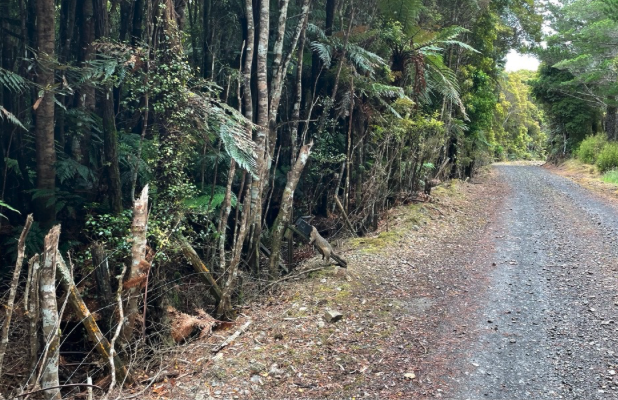
Figure 1. A possum caught in a kill trap, one of many set along a trapline.
Invasive species are often cited as a major threat to global biodiversity. Yet, the concept of “invasion” has come under sustained scrutiny from scholars across the humanities and ecology, provoking emotive debates and accusations of political or moral overreach. As I have argued elsewhere (forthcoming), this conceptual tempest might become more productive if insights from environmental humanities and science and technology studies (STS) are treated not as destabilising critiques but as analytical tools. Rather than debating whether the idea of “invasive species” is ecologically valid, I am more interested in what sustains these antagonistic relationships: the knowledge, beliefs, and practices they demand. One way to approach this question is to examine killing as care.
This short essay draws on ethnographic fieldwork conducted in Aotearoa New Zealand in early 2025. New Zealand, with some of the world’s strictest biosecurity measures, has a long history of lethal invasive species control and post-colonial conservation politics. Ginn describes this as an eco-nationalist project that orders human and non-human lives, while working to “sanitise the colonial expropriation” of the land under the shared love for nature, leveraged as an “apolitical” way to unite communities under one ecological imaginary—a future without invasive species. This is made even more palpable by Predator Free 2050 (PF2050), an initiative launched by the government in 2020 aimed at eradicating all rats, possums, mustelids, and feral cats (recently announced) by mid-century. It is important to note that most of my interlocutors were Pakēhā (settlers of European descent), hence the materials here reflect a situated set of values and relationships and do not capture Māori viewpoints.
In acknowledgement to the considerable body of scholarship that challenges killing animals that are labeled invasive (e.g., van Dooren, Wallach et al., and Kopina & Coghlan among others), the research here does not contribute to that critique but rather inquires into the act of killing. The following considers killing as a form of greenwork and “how to kill kindly” as a form of environmental care1. Drawing on McLauchlan’s and Palmer et al.’s insights on the need to “hold tension and discomfort” in conservation practices, I see kindness as one way to approach the rich discussion of multispecies care and frame it as resistance to acquiescing to the moral certainty of killing invasive species by negotiating cruelty. How is kindness measured, distributed, and justified when caring requires culling?***
Killing for Conservation in Aotearoa New ZealandBecause of New Zealand’s long biogeographical isolation and relatively recent human settlement—Polynesian voyagers settled less than 800 years ago—species nativeness is unusually clear-cut. Endemic species evolved without mammalian predators and therefore lack defensive adaptations. Their endangerment is understood as an ecological, cultural, and economic harm.
Against this backdrop, PF2050 mobilises not only state agencies, but also NGOs, scientists, tourists and civilians around an extermination-oriented vision of conservation. While critics have argued that this focus sidelines habitat protection and structural drivers of biodiversity loss, PF2050 has gained remarkable public support, evidenced by the expansion of local predator-free units, community-led initiatives, and NGO partnerships. Alongside aerial poisoning campaigns and professional trapping, citizens are encouraged to participate by setting traps in their backyards.
One consequence of this national mobilisation is the rapid development of new trapping technologies. Traps are increasingly designed to be safer, easier to service, and deliver the lethal strike more tidily and reliably. Traps however are only a killing device; they require regular, manual maintenance and servicing to deliver the killing-as-designed. In the following, I outline three ways to see killing as greenwork of care on the side of the “killers”.
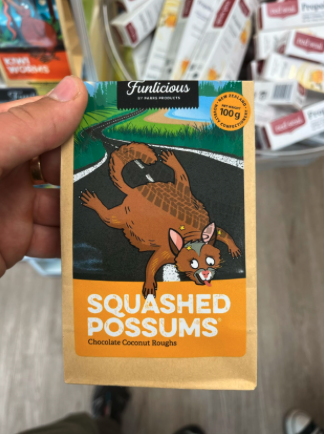
Figure 2. A bag of chocolate named “Squashed Possums.”
1. Work on Categorisation and Individualisation
At my first field site—a privately run eco-sanctuary—hostility toward target species was common among volunteers. Shortly after arriving, I watched volunteers jest at possum roadkills and throw rocks at possums in trees. In a group chat, volunteers exchanged cruel jokes, such as sharing photographs of a bar of chocolate labelled “squashed possum” (Figure 2). In the sanctuary’s lunchroom, a “Kill Book” tallied animals trapped each day. Accidental by-catch, like rabbits or blackbirds, was not unusual. Oliver2, the sanctuary owner, responded indifferently to my question about them: “They weren’t native, so it didn’t matter.”
For Oliver, this work of categorisation of what’s killable was essential to manage the volunteers, most of whom are young tourists from the Global North. The moral boundary between invasive and non-invasive expanded into one between native and non-native. The clear killability of unwanted species motivates volunteers to handle deceased animals and perform conservation tasks in difficult terrains. While he told me in private that there are no easy answers, he also admitted that he had “no time to deal with ethics” as he just needed the volunteers to “do their job” and that the animals “die anyway”. At times, his sanctioned disregard for unwanted lives had serious consequences. A volunteer who had quit the program after I left told me that a live-capture trap had been left unchecked for days, and a magpie trapped without food or water, which could be a criminal offence. Here, the withholding of kindness is tactical; it allows volunteers to service trap lines without protest. Although Oliver personally acknowledges the moral nuances, he chose to stabilise a simplified moral script for killable invasives by not revealing his own ambiguities. The magpie was shot in the end; but the thought of kindness would have made a difference before its death.
2. Work on Neutralising Violence and Emotion
My interlocutors were not oblivious to the violence and moral questions involved in culling animals. Some of them—whom I met in the other two fieldsites—have developed practices to live with it. Simon, a professional trapper working for a conservation NGO, shared a secret that his colleagues didn’t know: whenever he had to kill a live animal, he would say a small prayer, hoping it would return in its next life as a native species. He also avoided waste: stoats were kept to scent traps and feral pigs were gifted to local Māori communities. Ned—an independent trapper and trap inventor—embraced grief and moral uncertainty more openly. He kept the kittens whose mother had been killed in a trap as pets, and somehow befriended a possum who had survived the lines of traps on his land.
These shifting positions show the liminal position of my interlocutors, as they switch between the roles of killer and carer. This reflects not only changing relations with the target animals (as a member of an invasive species or as a sentient individual), but the care in navigating responsibility amid contingency and contradictions between what they say and what they do. Kindness here lies in the unease and uncertainty: it makes the act of killing morally visible rather than an unquestionable conservation routine.
3. Work on the Mandates of Killing
For Oliver and Simon, both immigrants, their conservation work was also a means of claiming a sense of belonging in New Zealand. Killing invasive species is a token of loyalty to the indigenous biodiversity of their new home—a pledge of allegiance to the land. For Oliver, income from paying volunteers sustains his livelihood and connection with the local community and the Department of Conservation, enabling him to care for the sanctuary full-time. For Simon, moving from unemployment when he first arrived, to being a pig hunter and beekeeper, to now being a respected pest control operator, gives meaning and value to his identity in New Zealand.
For Ned, born and raised in New Zealand, the question was different. He openly challenges the radical agenda of PF2050, opposes the promotion of hatred against the target animals, and questions the ethical and ecological justification of aerial poisoning. For him, each animal of the group of invasive predators remains an individual; some are spared, some killed, and some mourned. His commitment to the land is manifested through his care for native biodiversity as much as for the animals he is tasked to kill in its name.
***
Seeing killing as care clarifies how kindness can be seen in the presence of doubt—in prayers whispered over bodies, in grief for kittens orphaned by traps, in the hesitation of those who dislike killing yet continue the work. Kindness, however, is distributed unevenly, not only structured by classifications of native and non-native, but also, on the side of the killers, it depends on how and when kindness affects the work of killing-for-conservation. For the inexperienced volunteers (from Oliver’s viewpoint), a reminder that kindness could have a place in killing only disrupts the narrative and practical cohesion that some invasive animals should die; for the seasoned trappers, the acknowledgement of cruelty and moral uncertainty brings reconciliation. As invasive species control necessarily entails violence, kindness in this context does not resolve contradictions or deliver conservation from the moral trouble of killing. But kindness resists the moral certainty that makes killing routine and unquestionable—staying with this troubled care may be key to moving forward with conservation’s never-innocent work.
1 Some of the ideas in this essay were presented in the Greenwork and Environmental Knowledge panel organised by Matthew Eisler and Hannah Rogers for the 4S Seattle conference. I am grateful for their insights on greenwork as a lens to revisit how society in relation to the environment has been perceived through work and as a result of prevalent environmental regulations, which have shaped my ideas.
2 All names are pseudonyms.
Bio:
Katie Kung is a PhD candidate in Environmental Humanities at the Rachel Carson Center in LMU Munich. Her doctoral project, titled Troubled Care: Invasive Species in a More-than-Human World, examines biological invasions through the intersection of multispecies studies, STS and political ecology, linking care to more-than-human conflicts and violence. She is also an editor for Environmental History Now, a platform for early-career FLINTA researchers. www.katiekung.com @katiekung.bsky.social
Published: 03/02/2026