Between the Lab and the Clinic: Perspectives from Medical Humanities and Science and Technology Studies (STS)
Kristin D. Hussey (Newcastle University), Hannah Star Rogers (University of Copenhagen)
Edited by: Aaron Gregory (University of California, Riverside) 03/16/2026Reflections
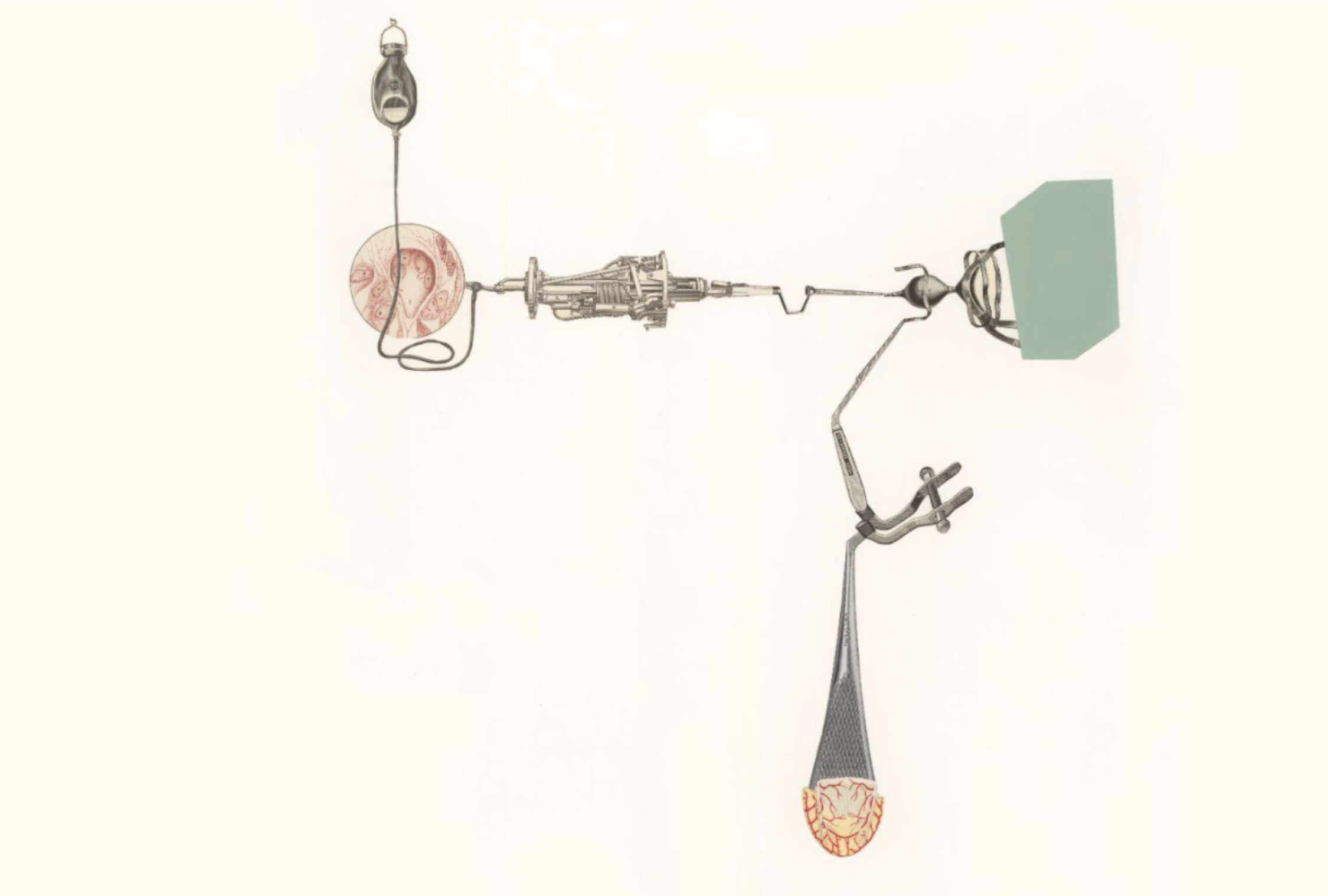
(Image Credit: Kirsten Stolle, Animal Pharm-1. Collage on paper 30 x 22, 2014)
The lab is a space that has dominated STS scholarship since the 1980s - with theorists interrogating the forms of knowledge produced there and its transit in and around society. We can see the clinic playing a similar role in the Medical Humanities, a spatial focus in which to unpack the relationships between doctors, patients and medical knowledge. Yet, these spaces, and these fields, remain quite distinct, even as both groups understand the edges of these spaces and their imaginaries as places to think with and along. Together, we wondered what might happen if we brought the lab and the clinic - and the intersections between them - more in to focus. We ask, what more can we gain in the Medical Humanities from a critical engagement with the lab, and in STS from a renewed consideration of the clinic?
The post presented below, written by Kristin D. Hussey and Hannah Star Rogers, was originally posted on The Polyphony, Conversations Across the Medical Humanities. The piece seeks to connect STS and the Medical Humanities and the lab and the clinic. We have chosen to present it here on 4S Backchannels in the spirit of bridging these two fields. The piece was prompted by the authors’ visit to the Durham University Platform for Medical Humanities following an invitation from Fiona Johnstone to speak at a Platform Summit on the theme of ‘Labs’. In this piece, the authors examine the expanding use of the term “lab” in the Medical Humanities and argue that this shift merits critical examination through the perspectives of Science and Technology Studies (STS). In recent years, humanities research groups have increasingly adopted laboratory terminology and institutional structures mirroring the organizational models of scientific research environments, a process both illuminating and fraught, but certainly one familiar to STS scholars. Connecting the intellectual space of the Medical Humanities’ emphasis on the clinic and STS’s approach to the laboratory, the authors propose the productivity of further exchanges between these two fields around these complex concepts.
Kristin D. Hussey and Hannah Star Rogers draw on Science and Technology Studies (STS) to think through how the ‘lab’ is being employed across the medical humanities.
Over the past ten years or so, the word ‘lab’ has found its way out of scientific contexts and into many other areas of study and commerce. For example, at Medical Museion at the University of Copenhagen, the humanities researchers have been formed into ‘labs’ led by Principal Investigators. This mirrors the structures of Museion’s sister scientific lab, the NNF Center for Basic Metabolic Research (CBMR) from which much of their funding is derived. At Durham University, the Medical Humanities Institute has re-branded itself as a ‘Platform’ in the wake of new funding from the Wellcome Trust, deploying another scientific term more typically used to describe computational hardware or software. The Platform also consists of multiple research hubs, or ‘labs.’
What do groups of medical humanities scholars have to gain by using the term ‘lab’? What precisely is meant by this, and what functions of the rhetoric and practices of traditional scientific laboratories is brought into this new context? We suggest it is a rhetorically and strategically useful move. Given the current funding landscape in which funders who traditionally back scientific research seem to be some of the last with financial support to lend, humanities scholars often must speak the language of science (Newfield, 2025). Co-opting the language of science is understandable in our current context, but as Science and Technology Studies (STS) scholars, we are left wondering whether this move to the ‘lab’ has been accompanied by sufficient critical reflection by medical humanities practitioners.
Far from a sanitary, neutral places of ‘objective’ work, historians and STS practitioners have demonstrated that scientific research- both the places in which it occurs and the people who do such work- always exist within social, technological, and political contexts. In their influential work on ‘objectivity, Lorraine Daston and Peter Galison (2007) track the specific social and historical contexts of a concept that is so central to scientific practice today. The work of STS scholars encourages us to think critically about the place of science in society – and crucially, about the places in which that science is done. In this piece, we reflect on how STS scholarship can help medical humanities scholars think critically about the ‘lab’. Drawing on our own research within the History of Science and Art, Science and Technology Studies, we explore how these approaches have helped to de-mystify the lab, and how the boundaries between ‘science’ and ‘medicine’ are becoming increasingly blurred.
What is a ‘Lab’?
What is a laboratory? It is a question with multiple answers. A laboratory can be a space, a frame of mind, a method, a classroom, and so on. Kristin Hussey’s research has explored how in the nineteenth century, a lab might be a hospital ward, an asylum cell, or a drawing room; these diverse spaces were used as sites of experimentation and investigation (Hussey, 2021). Today the language of the lab is widely used within the humanities: we have feminist labs, queer labs, indigenous labs, and of course, medical humanities labs (Pawlicka-Deger and Thomson, 2023). But the laboratory is also a place where scientists do their research. When most of us use this word, we imagine a particular kind of space, isolated, protected from external influences, made of lab benches, complex machinery, and scientists in white coats. The lab is a place that is defined by its placelessness. As historian of science Robert Kohler explains:
‘The power of laboratories in modern science lies, oddly, in their separation from the world of nature. It lies in their generic placelessness, in their lack of the particularity that makes every place in nature different from all others. Labs are all the same (more or less) and constitute a universal cultural space; that is why we trust the knowledge produced in them to be universally true’ (Kohler, 2002, 473).
It is this view of the lab – as a placeless and universal space in which to locate ‘objective’ truth – that is so attractive to funders. Looking to the work of STS scholars can help to place the lab into critical context and open new avenues of research for the medical humanities.
The Lab in STS
STS began with the laboratory as a central site of inquiry during the late 1970s and early 1980s, with the emergence of laboratory studies. This foundational body of work saw sociologists and anthropologists enter laboratory settings to conduct interviews, undertake ethnographic research, and observe day-to-day work practices. Their aim was to analyse the organisational structures and cultural norms that shape scientific knowledge production within these environments.
The observations here are grounded in three texts from this tradition: Bruno Latour and Steve Woolgar’s Laboratory Life (1979), Mike Lynch’s Scientific Practice and Ordinary Action (1993), and Karin Knorr-Cetina’s Epistemic Cultures (1999). These works collectively laid the foundation for what became known as laboratory studies. Knorr-Cetina defines this subfield through its methodological commitment to direct observation and participant-observer approaches (1981, 1999), where analysts join laboratory practices and environments, revealing how technical decisions, protocols, and outcomes are shaped by social processes. For scholars engaged in laboratory studies, laboratories are not simply neutral sites where nature is revealed. Rather, they are spaces that actively stabilise, construct, and preserve specific phenomena.
We might draw a parallel with the ways that medical humanities scholars have come to critically examine the ‘clinic’ as a space. Emerging from the work of thinkers like Michel Foucault (2003), from the 1980s and 90s, the clinic (and the hospital) became re-framed not as neutral sites of medical care, but as spaces enmeshed in politics and power. The interrelationships between the lab and the clinic are complicated, even more so in our modern age of biomedicine. Numerous diagnostic techniques, such as pregnancy tests, blood glucose monitoring, influenza detection strips, and COVID-19 testing kits, which were once confined to laboratory settings, have become increasingly accessible within clinical environments and even as at-home diagnostic tools. Consequently, knowledge regarding disease, wellness, and patient status circulates fluidly across various contexts.
The Lab and the Medical Humanities
Over the last two decades, the study of the laboratory has largely been the domain of STS and lab studies scholars. But what is the status of the lab within the medical humanities? Part of the challenge is that many scholars of the medical humanities see their work as explicitly working to counterbalance that of a de-humanising, science-derived form of biomedicine. As William Viney, Felicity Callard, and Angela Woods have observed, ‘The medical humanities is presented as a counterbalance to the restrictive and restricted views of science’ (2015, 3).
This does not mean that the lab had not been present in discussions of the clinic. For example, in the emerging ‘translational medical humanities’, scholars are interested in how the ‘bench to bedside’ movement (the process of turning scientific insights into clinical interventions) might be usefully complicated. Inspired by trends in the biomedical sciences, scholars working in the translational medical humanities explore how basic ‘bench’ science done in the lab exists in perpetual conversation with ‘bedside’ clinical practice. Much of this work focuses on thinking about biomedical science as a part of broader medical cultures, interrogating the ‘in-betweenness’ of research and practice, as in this ‘translational chain’ (Engebretsen, Henrichsen and John Ødemark, 2020). This move acknowledges that almost all medical practice is now founded on research which occurs in laboratory spaces.
Elsewhere, the lab is beginning to creep into wider medical humanities work. In her work with genetic testing and assisted reproduction, the historian of science and medicine Jenny Bangham thinks about the way discussions around genetic counselling have brought together patients, doctors, and clinical geneticists to interpret biological data and make choices about the future lives of often disabled children (Bangham, 2014). Researchers from the Animal Research Nexus in Oxford (Davies et al., 2020) look at the experiences of laboratory animals to interrogate questions around care, personhood, and interspecies relationships since animals stand in for humans in experiments, informing human health and medical practices. Medical philosopher Sarah Yvonnet has worked on how the diagnostic labels for diabetes determined in the laboratory come to influence clinical practice (Yvonnet, 2025).
The complex inter-relationships between patients, scientists, labs, and clinics leaves more to be unraveled by medical humanities scholars. Tests and procedures migrate between the lab and clinic, taking on different meanings and functions depending on their spatial and temporal contexts. For example, any distinction between what constitutes a laboratory and what defines a clinic frequently encounters practical and conceptual challenges. Shannon Mattern has theorised about the importance of the notion of the kit more broadly and the values it carries out into the world, away from spaces of expertise (2021). Consequently, knowledge regarding disease, wellness, and patient status—though often anonymised—now circulates fluidly across these various contexts. We suggest STS can serve as inspiration as the medical humanities is increasingly confronted by the presence of the laboratory in medical practice.
Blurring the Boundaries
Blurrings and boundary crossings between medicine and science activate sites of knowledge-making in ways that make insights from the medical humanities and STS of use to one another. Hannah Star Roger’s interests in this area involves connecting STS theories to art-science works (through the emergent area of Art, Science, and Technology Studies or ASTS). Questions of clinics and laboratories come up often in art-science circles and have repeatedly been of interest in ASTS work. In one recent conversation we had with the Artistic Director of the Bioart Society, Yvonne Billimore explains how the clinic and lab are understood in a blurred way in her field:
“I think sometimes “the lab” and “the clinic” are used fairly interchangeably within the field of art & science, and often without addressing their distinct uses. As we utilise, or even play with, the concepts and institutions of “the lab” and/or “the clinic”, reframing them as sites for emergent interdisciplinary investigation and experimentation, we must be conscious of their historical and contemporary functions—shared and specific.”
The stakes of these shared histories become clearer as Billimore explains how institutional structures inform subjects and, indeed, particular political positions:
“Both institutions of biological research and knowledge, one a place for studying (life)sciences at large, the other dedicated to defining and “treating” health, their trajectories have been/are determined by wider socio-political systems, particularly the biomedical and commercialised bio-industrial complex. If we are to inhabit these institutions conceptually and/or physically we must respond to their wider influences and how these inform their particularities.”
Billimore’s reflections point toward a crucial dimension of how laboratories and clinics may be reimagined beyond their conventional biomedical functions. For artists, medical humanities, and STS scholars, as well as practitioners, the challenge lies not only in borrowing the laboratory language or aesthetics but in interrogating their underlying ideological logics, i.e., of capitalism, racism, colonialism, and ableism. These lead to further questions about the role of the artist in a framing of science and medicine captured by capitalism, and its relationship to the use of the terms lab and clinic. This leads Billmore to ask:
“How can the laboratory be (re)appropriated without considering how it operates within capitalism and the ways in which biological science is driven by market forces? How can the clinic be approached without attending to the violence inflicted on bodies that do not fit gendered, racist, ableist ideological norms? Amongst others, these considerations should be guiding how we move in and move the parameters of each.”
Artistic interventions can render visible the tacit assumptions of laboratory and clinical practice, complementing the analytic tools developed in STS. By acknowledging the porousness between art, science, and medicine, scholars are invited to consider how creative practices expand the methodological repertoire of the field.
Whether in laboratories, clinics, or studios, knowledge emerges through dynamic negotiations among multiple actors, institutions, and material practices. Recognising this interconnectedness- of space, people, ideas- allows for more nuanced critiques and more imaginative possibilities for the future of medicine and science. As medical humanities scholars learn to navigate their new ‘science-ified’ workplaces, STS can provide useful insights and frameworks through which to critically interrogate not only the role of the laboratory, but the relationship of science to medicine and the wider humanities.
With thanks to Dr Fiona Johnstone and the participants of the recent ‘Labs in the Medical Humanities’ seminar at the Durham Dicovery Research Platform for Medical Humanities.
Author Bios
Kristin D. Hussey, PhD is Lecturer in Environmental History at Newcastle University. She is a historian of science, medicine and the environment in the modern period. https://kristinhussey.co.uk/
Hannah Star Rogers, PhD is assistant professor at the University of Copenhagen, based at the Medical Museion. Rogers is an Art, Science, and Technology Studies scholar, curator, and poet. https://hannahstarrogers.com