
Marisol Marini (University of São Paulo)
Edited by: Bri Matusovsky (University of California, San Francisco - University of California, Berkeley)
04/13/2026 Reflections
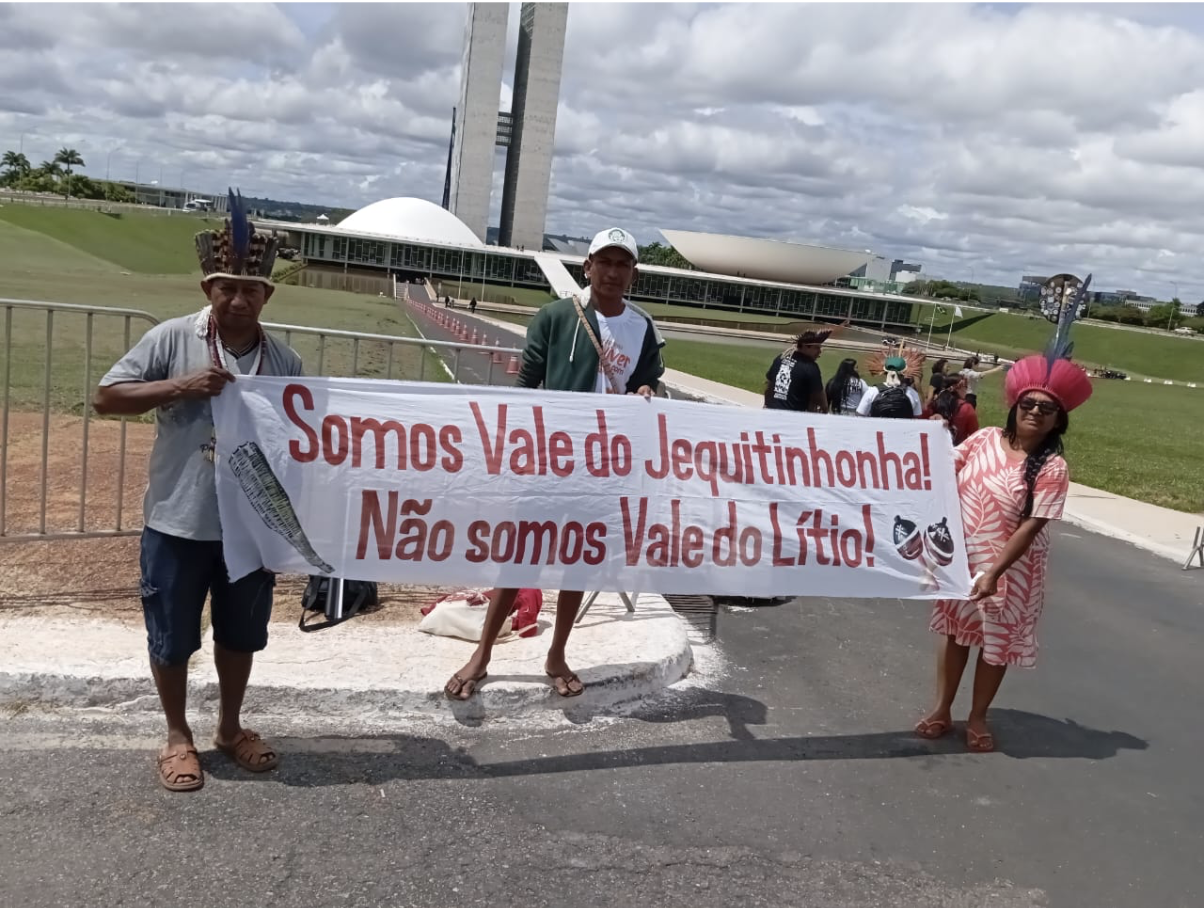
First Nations people from the Pankararu and Aranã Caboclo ethnic groups at the 21st Free Land Camp (Acampamento Terra Livre - ATL) in Brasília, 2025, which brought together thousands of Indigenous people from all over Brazil. Photo provided with permission from Osmar Marcelino Miranda, coordinator of the Aranã Caboclo people, located on the left of the image. Next to him are Cleonice Pankararu and Gerson Antônio Pankararu (in the middle).
This article seeks to contextualize the situation of the Jequitinhonha Valley, in northern Minas Gerais, which holds the largest lithium reserves in Brazil. Lithium is a strategic mineral for the energy transition to carbon-free fuels. Lithium mining leads to the double degradation of the landscape and its inhabitants, who have been historically marginalized and exploited. I developed the concept of “the Common Body” in my research project to describe the interpenetration and reciprocal affectation between bodies. In response to double degradation, local peoples align themselves with the lands and ecosystems within which they live. Understood as a conceptual, epistemological, and political tool, the Common Body aims to name and address the convergence between human and ecosystem health in situations of territorial conflict. It is a way of framing the Anthropocene embodied in the lungs, in the bloodstreams, in the river waters crossing the territories, penetrated and contaminated by toxic pollution.
Sacrifice Zones - Vulnerable Common Bodies
In the Jequitinhonha Valley, between 2022 and 2023, mining activities totaled 500,000 hectares of land in imminent territorial conflict, impacting rural communities, quilombola (Afro-Brazilian) communities, and First Nations lands. In the first four months of 2023 alone, 188 lithium-related mining processes were opened, an amount equivalent to the total number of processes previously registered over 48 years, from 1973 to 2021. The region experienced unprecedented deforestation between 2000 and 2014, coinciding with the highest recorded temperatures in Brazil in recent years.
Within the so-called lithium triangle in Latin America, encompassing the borders of Argentina, Bolivia, and Chile, the Jequitinhonha Valley is characterized as a sacrifice zone in the context of energy transition and energy justice. “Sacrifice zones” are geographies where socio-environmental conflicts have negative implications, especially for traditional populations, historically exploited by the colonial machine. Extreme damage to the environment and to marginalized people, to their ways of existence, to the health and vitality of their bodies, are intimately connected within sacrifice zones. Sacrifice zones are a form of spatial injustice (Hecht, 2023), a deliberate, spatialized discrimination that exposes historically marginalized local populations to high levels of toxic pollution. In the specific case of lithium mining in Latin America, the term sacrifice zone refers to socio-environmental impacts, degradation, and lack of access to potable water (Janubová, 2023). These regions do not benefit from mining profits or the energy transition, as the lithium extracted there supports the European Union's decarbonization efforts.
Issues related to the profound interrelation between environmental exploitation and racial violence, which has been described as environmental racism (Davis, 2022), are supported by racial capitalism (Hecht, 2023). As Angela Davis (2022) rightly points out, environmental racism is not only about who is most vulnerable to environmental pollution.
The analytical and political commitment is not only to understand how environmental dangers are experienced unequally by human beings, but to dismantle the systems - colonialism, racism, patriarchy, and speciesism - that allowed the construction of a world based on environmental exploitation and destruction.
In this context, these so-called "renewable energies" mirror the political economy of fossil fuels, constituted by the logic of petro-masculinity (see Daggett, 2018), reinforcing the historical role of fossil fuel systems in strengthening white patriarchal dominance. Petro-masculinity describes how the anxieties aroused by the Anthropocene can intensify desires for authoritarianism. This idea highlights the correlation between ecological crises, racism, and misogyny, evidencing their toxic and destructive combination.
Environmental dangers are experienced unequally by human beings, and racism and sexism create the conditions of possibility for attacks and assaults on the environment and the lives of people who it devalues. Sacrifice Zones are toxic infrastructures that weaken the health of ecosystems and human collectives that have historically been made disposable and exploitable, promoting the disarticulation of ways of inhabiting the world.
The Logics of Neo-extractivism
Lithium mining in Latin America is part of the agenda of “green extractivism,” the extraction of resources that support a purportedly sustainable, emission-neutral economy to mitigate climate change. Green or neo-extractivism is an economic model based on the intensive exploitation of primary goods and resources, the mining of materials for "clean technologies” rather than carbon-based fuel sources like coal, oil, or natural gas. Green extractivism has been used to justify the destruction of the environment and the social structures of certain vulnerable populations in the name of sustainable development (Isla, 2022). The acceptance of these "renewable energies" as sustainable disregards the negative environmental impacts of mining, labor, and the unsustainable energy costs needed to build, install, and operate this infrastructure.
Over the past two decades, and paradoxically under progressive and liberal governments, neo-extractivism has been legitimized and expanded in Latin America. Neo-extractivism has reinforced inequalities and increased socio-environmental and territorial conflicts. In such Sacrifice Zones – territories where environmental damage is experienced and justified as the cost of progress – the shared vulnerability between people and ecosystems is a matter of scale. Degradation and toxicity are not side effects but are central to the unfolding of a policy agenda (see Liboiron, 2023) that expropriates certain bodies (human and more-than-human) and their vitality, based on the separation between Man and Nature, which authorizes their exploitation and expropriation (see Ferdinand, 2022).
The Common Body as a Concept for Resistance
As a metaphorical antidote to the pernicious effects of Sacrifice Zones, the Common Body describes how people reclaim non-commodity-based relationships to the land. Local traditional peoples in the Jequitinhonha Valley have strengthened their historically constructed tools of resistance in the face of colonial threats and ecosystem challenges, such as the region's droughts.
The Common Body is a research project and agenda based on distinct empirical cases, all of which are related to the convergence of human and ecosystem health, highlighting strategies of resistance and alliance between people and more-than-humans. Extrapolating the body as an analytical and political concept across overlapping scales, the Common Body challenges reductionist and anthropocentric strategies in health care. The common body is an auxiliary theoretical tool to strengthen these territories and their sovereignty.
In the conception of the common body, there is a reciprocal affectation between bodies. The Common Body focuses not only on the porosity evidenced in transcorporeality (see Alaimo, 2008), but above all on intersectionalities, inequalities, more-than-human interdependencies, and the historically constituted abilities of cohabitation and solidarity. At the heart of the common body is the importance of incorporating other epistemologies into policies and hegemonic thought. The common body does not flatten differences, but radicalizes the idea of the planet as a body, extrapolating the value of the body as an analytical category to other more-than-human entities, including the atmosphere, ecosystems, and other living beings.
The Common Body relates to the need for new kinships (Haraway, 2016; Bellacasa, 2017), new forms of alliance and solidarity, including new immunological understandings that extrapolate the body to more-than-humans. Immunization that goes beyond the limits of the skin and the warlike vocabulary (Martin, 1990) of invading agents that must be eliminated and against which a barrier is closed and constantly reinforced.
When examining the everyday impacts that unequally affect different groups, it is necessary to consider the arrangements between humans and other more-than-human beings that have developed skills for coexistence and forms of solidarity. This involves insisting on considering other ways of world-making, as Malcolm Ferdinand suggests, that do not share the modern environmental fracture. A world-making that bets on the political composition between pluralities, which includes the earth, humans, and non-humans, aiming at the establishment of a common world.
Considering the Common Body as a tool that is both diagnostic of shared vulnerabilities and a speculative instrument for naming and recognizing interspecific alliances, the Common Body should be taken as a commitment, as the pursuit of developing skills and healthier ways of inhabiting and relating to bodies and worlds in ruins (Tsing, 2015).
___________________________________________________________________________
Marisol Marini holds a bachelor's degree in Social Sciences, a master's degree, and a PhD in Social Anthropology from the University of São Paulo (USP), with a research stay at Maastricht University in the Netherlands. She worked as a postdoctoral researcher at the State University of Campinas (Unicamp), in the Department of Science and Technology Policy, at the Institute of Geosciences, and at McGill University, in the Department of Social Studies of Medicine, in Montreal, Canada. Throughout her research career, she has used qualitative empirical methods to describe and analyze the emergence of new medical knowledge and technologies, as life-extension devices, which has brought her closer to debates on mortality, extinction, and ecological, epistemological, political, and civilizational crises, which have led to current research on the Anthropocene, toxicity, pollution, territorial conflicts and ecological crises. She is associated with the socio-environmental component of the AmazonFACE Program, investigating the interface between science and politics. She is a member of the project "Unsubmissive Ecologies in the Anthropocene: biodiversity, climate and health on the borders of the Lusophone world in the 20th century", linked to the research group "History, Health and Ecology in the Anthropocene" at the Oswaldo Cruz House. Recently, she was a visiting researcher at Technische Universität Berlin (TU Berlin) in the Institute for Architecture (Project: Planetability: Integrating Planetary Health and Species Cohabitation in Urban Design and Research) from November 2025 to January 2026. Currently, she is an Associate Researcher at the Faculty of Public Health of the University of São Paulo, where she coordinates the project and the research group "Common Body - A non-anthropocentric approach to the unavoidable convergences between Human and Planetary Health", financed by FAPESP.
Note from the author: I want to thank Bri Matusovsky, without whom this publication would not exist. Besides inviting me to write it, Bri generously collaborated on structuring the argument and revising the text.
Published: 04/13/2026