
In the city of Pasadena, California, a proposed water reuse project has ignited contentious debates and fierce community advocacy regarding the nature of infrastructural "fixes" and the futures which infrastructure serves. The Arroyo Seco Reuse and Natural Stream Restoration Project (alternately called the Arroyo Seco Canyon Project) is a proposed collaborative project between the cities of Pasadena and South Pasadena which aims to “address water quality issues and assist in complying with a state-mandated requirement to reduce the bacteria levels from tributaries that flow into the Los Angeles Rivers,” funded in part by the State of California, Department of Parks and Recreation, and Los Angeles County’s Safe, Clean Water Program (Measure W). The Stewards of the Arroyo Seco, as well as prominent community organizations, elected officials, and other grassroots groups, oppose the project, citing a range of environmental and equity concerns and advocate instead for "natural" or "nature-based" solutions to these issues.
At the heart of these debates are questions which have long preoccupied science and technology (STS) scholars regarding the infrastructure/environment divide and the boundaries of infrastructure (Howe et al. 2016; Larkin 2013). Early scholarship in the field highlighted that infrastructure takes form as an analytic category when the distinction between figure and ground occurs (Bowker 1994), or when infrastructure appears as the background to another process. Infrastructure’s invisibility or “sinkness” into the background depends on work/practice; in other words, infrastructure is a relational concept – “within a given cultural context, the cook considered the water system a piece of working infrastructure integral to making dinner; for the city planner, it becomes a variable in a complex equation” (Star & Ruhleder 1996). Recent work on climate change has further complicated the notion of infrastructure as mere “substrate” as the Anthropocene, or the new planetary epoch defined by humans as the dominant force shaping Earth’s bio-geophysical composition and processes, unsettles this distinction (Chua & Fair 2019; Muehlmann 2019). The Anthropocene “unsettles the relationship between nature and culture, humans and nonhumans,” as we see in the resistance of environmental phenomena, such as aquifers, to be “infrastructuralized” (Ballestero 2019; Hetherington 2019; Howe et al. 2016).
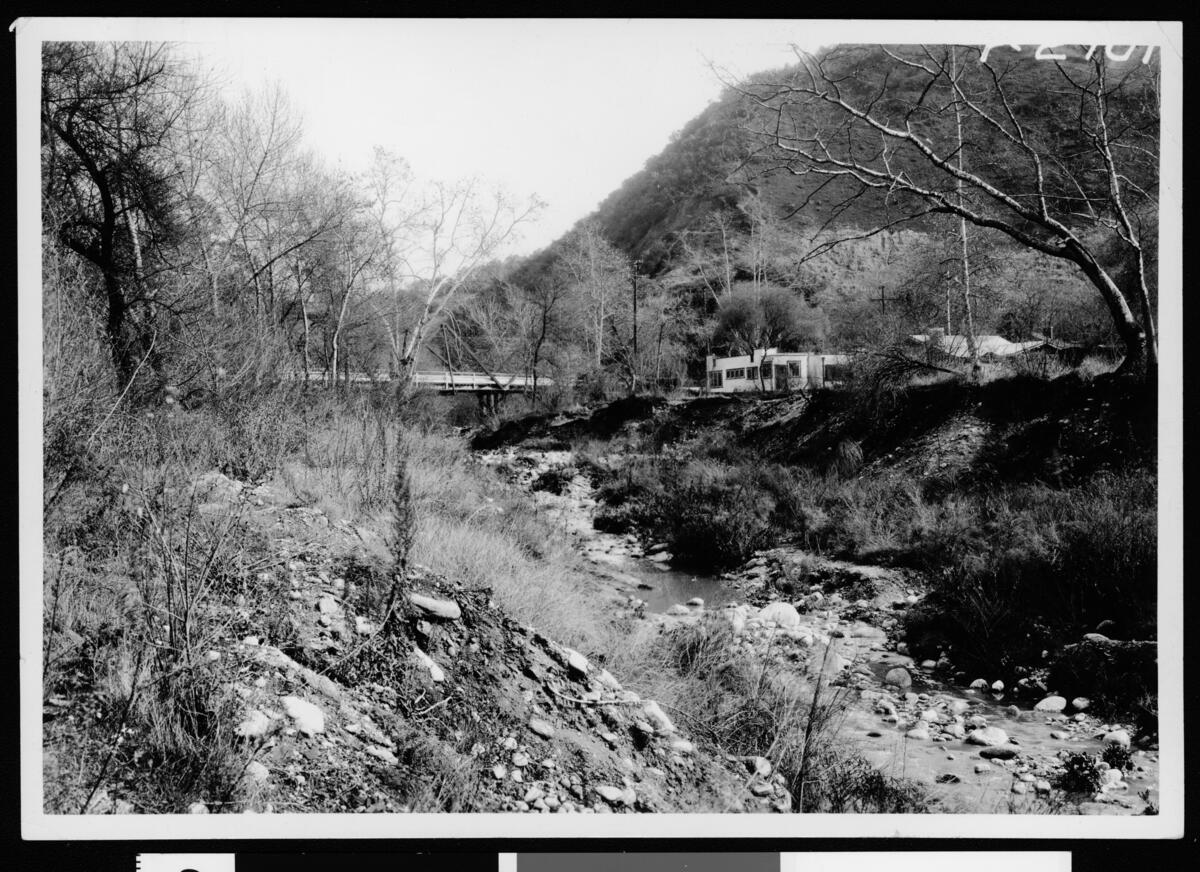
View of the Arroyo Seco before installation of the channel, circa 1930. Credit: University of Southern California. Libraries and California Historical Society.
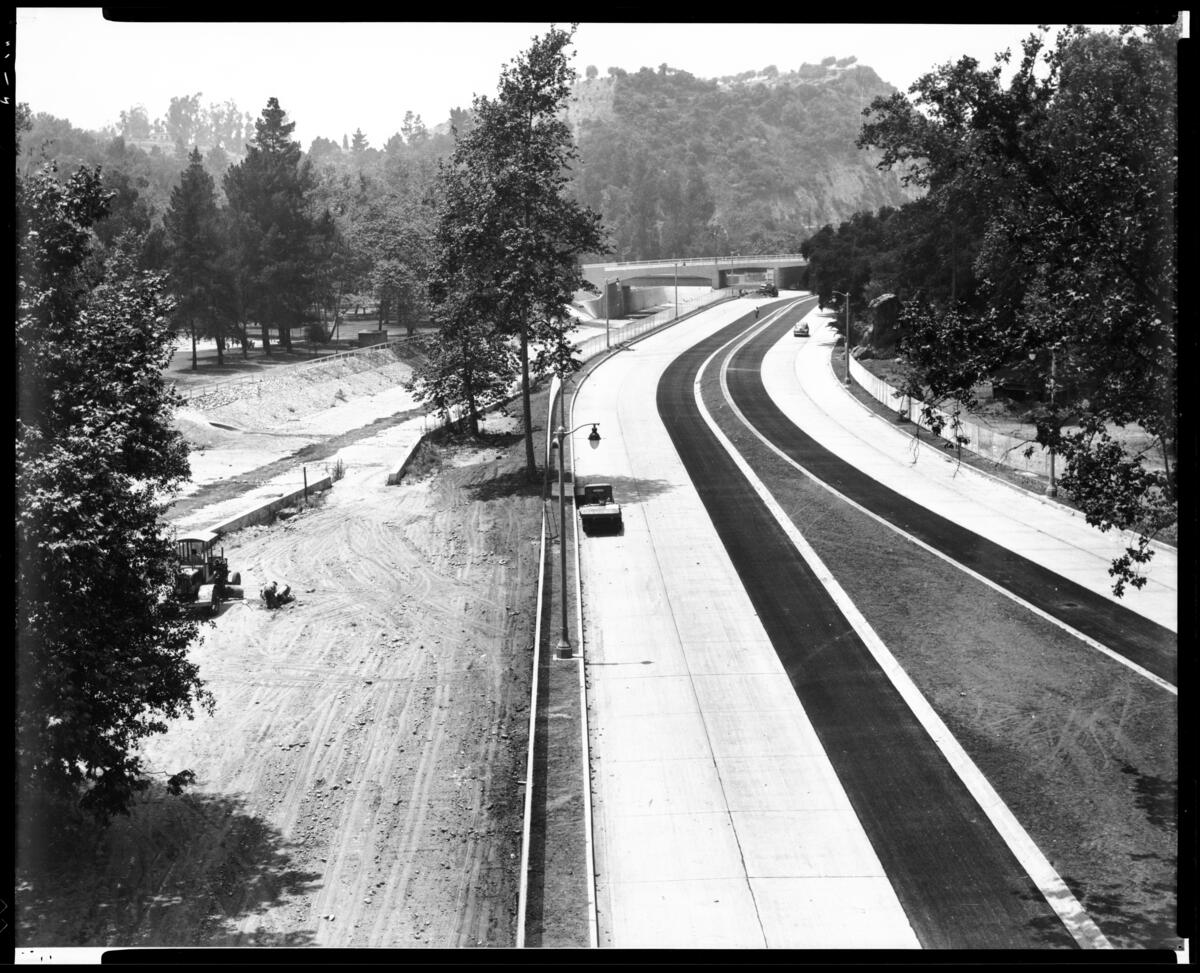
The proposed water reuse project in Pasadena consists of two stormwater management locations alongside the Arroyo Seco Channel, a natural river spanning 22 miles which, in the 1930s and 1940s, was concretized in response to disastrous flooding: (1) the San Rafael site, and (2) the San Pascual site. At the San Rafael site, "runoff" heading towards the San Rafael Creek would be diverted, pre-treated, and infiltrated for groundwater recharge; the non-infiltrated portion would be “treated, discharged into the channel, and then diverted downstream into the San Pascual site for infiltration and additional treatment prior to discharge back to the channel.” The two sites would result in an annual average water supply benefit of 320 acre-feet (af), 258af of which would consist of groundwater recharge while 30af would be utilized for irrigation at the Arroyo Seco Golf Course.
The water reuse project also generates support and opposition, revealing infrastructure as a political matter of concern. In addition to water supply benefits and management of bacteria, proponents argue that the project would expand public open space, create new recreation amenities, increase public safety (listed in part as “unhoused and others leaving refuse, fire rings, human waste, etc.”) and create high-quality habitat, including constructed wetlands. Objections to the project include a flawed public engagement process, inadequate environmental reviews that resulted in a lawsuit by a community advocate, the cutting down of over 140 mature trees, lack of consultation with the Gabrieleño Band of Mission Indians – Kizh Nation and impacts to Tribal natural resources, damage to San Pascual Park, and destruction of ecological resources. While recognizing the need for solutions to water contamination and groundwater replenishment - in other words, the conditions "prior human degradation of environmental conditions" which drives the project (Howe et al. 2016) - many of these groups advocate for alternative and “natural solutions” to the project, including plans for habitat preservation and restoration. One petition includes language encouraging a “true nature-based solution,” while informational videos contrast “nature versus gray infrastructure” and “nature versus plumbing.”
In the Arroyo Seco Reuse Project, the proposed constructed engineered wetlands have emerged as a particularly heated point of debate regarding what constitutes “nature-based solutions,” a practice which requires untangling figure and ground, and identifying human action on the environment. Proponents posit that the project applies “nature-based approaches to the best extent feasible,” utilizing the Environmental Protection Agency’s position that constructed wetlands are examples of nature-based solutions “because they work with nature, not against it.” Opponents argue that they are effectively “shallow, lined-pools” which do not infiltrate water or promote groundwater recharge, would destroy a living riparian woodland, and constitute “demolition followed by landscaping,” as opposed to a “genuinely nature-based approach that would restore and enhance what’s already there.”
At stake is not only the future of the Arroyo Seco Reuse Project, but differing visions of the role of infrastructural intervention on the environment which continue to call into question infrastructure itself as category and as practice. Public debate regarding the project and community organizing in opposition continues. In July 2026, the Los Angeles Regional Water Quality Control Board issued a response to Pasadena’s Draft Environmental Impact Report which highlighted various disagreements with the city’s findings. The saliency of these issues among academics, practitioners, and community groups is reflected in the ongoing efforts of the most populous county in the United States to define, standardize, and scale nature-based solutions, and to differentiate between “green infrastructure, nature-mimicking, and true nature-based solutions." In Los Angeles County, these definitions will determine millions in tax-payer funding for allocations to environmental projects and doubtless influence classifications and standards across the nation (Star & Bowker 1999). They also carry the potential of determining "the nature of infrastructure” and acceptable levels for human intervention in the environment, processes which anticipate, make present, and decide upon our environmental futures (Barry 2020; Granjou et al 2017).
Author Bio: Gina Hakim is a Postdoctoral Scholar at the University of Southern California. She earned her PhD in Anthropology at the University of California, Irvine. Her research analyses how Mexican migrants' experiences in Los Angeles alters and informs environmental practices in their home community in Michoacán. Specifically, she focuses on how transnational collaboration has led to more democratic and participatory environmental governance.
Edited by Aaron Gregory
Published: 10/05/2026