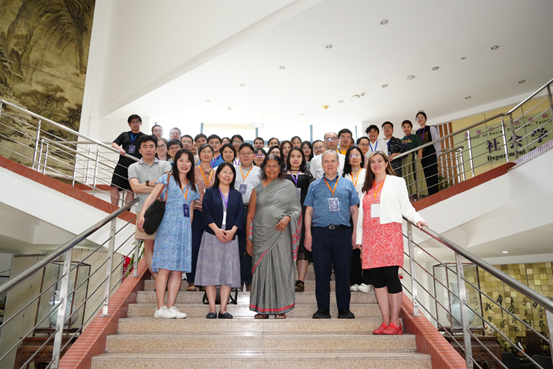
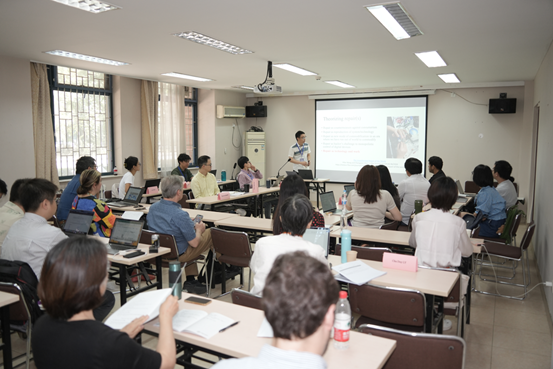
In June 2024, Tsinghua University and the Harvard-Yenching Institute (HYI) jointly organized a training program on Science, Technology, and Society (STS) in Beijing, themed “STS in Asia: Tackling Socio-Technical Challenges from an Interdisciplinary Perspective.” Co-organized by Associate Professor Wei Hong of Tsinghua’s Department of Sociology and Associate Director Ruohong Li of HYI, the 10-day program brought together 15 distinguished scholars from the U.S. and Asia, along with 19 trainees (doctoral candidates and early-career researchers).
The training program aligns with a broader, ongoing HYI initiative (launched in 2009) to support underdeveloped fields in the humanities and social sciences. This focus is particularly relevant for STS, which in mainland China is still often described as a “weak field without disciplinary affiliation”1,2,3. The aim of the training was therefore to cultivate the next generation of STS researchers in Asia by directly engaging them with leading international STS scholars. HYI also selected two visiting fellows from Asia to spend a year at Harvard after this training.
Over ten days of lectures, seminars, and case discussions, I—as program volunteer and auditor—not only revisited how STS as a field has taken shape but also began to grapple with a question central to its future: What would it mean to speak of STS in Asia as opposed to an Asian STS? Why does the distinction matter, and how might it reshape the field’s contribution to global dialogues?
1. The Call for a Situated STS in Asia
The intellectual starting point for our discussions was a call for a more situated STS. In her lectures on “Sinifying STS,” Susan Greenhalgh reminded us that theories forged in Western industrial democracies cannot be seamlessly transplanted to China. She identified three structural features that shape the Chinese context: (1) the enduring entanglement of science and the state; (2) a pervasive culture of scientism and techno-utopianism; and (3) a hierarchical stratification of disciplines according to state priorities. These conditions, she argued, make the localization of STS in China not merely desirable but necessary.
Greenhalgh’s call resonated far beyond China. Asia, after all, is not monolithic; it is diverse, heterogeneous, and culturally vibrant. As Sheila Jasanoff emphasized in her opening lecture, even technologies deemed “global,” such as AI, are always locally embedded, provoking very different challenges in China, India, and Japan. Any attempt to speak of Asia must therefore avoid essentialism and instead recognize its internal plurality, situating it within a symmetrical and dialogical global frame.
Credit: Zhanhong Wen, THU-HYI STS Training Program
2. Navigating a Productive Tension
Building on these discussions, the program navigated the productive tension between two complementary, yet potentially divergent, paths.
The first path, STS in Asia, involves introducing Euro-American theoretical frameworks to Asia. This was achieved through lectures by Stephen Hilgartner on knowledge-control regimes, Janet Vertesi on constructivism and Actor-Network Theory (ANT), and Ya-wen Lei on technology and work.
The second path, Asian STS, seeks to cultivate theoretical concepts emerging from within Asian experiences. This path reflects a long-standing collective ambition in the region. As Wen-hua Kuo noted in his talk, a key impetus for founding the journal East Asian STS was precisely “to create our own theories for Asian topics.” This is how the training program had a more practical and generative approach with participants actively modifying and engaging in conversation with existing Western theories based on Asian realities.
For instance, by using ANT to study “care dolls” in South Korea, Chihyung Jeon did not merely apply the Western analytical framework but very much infused the theory with new local, empirical substance through engaging with culturally situated meanings of “care” in an aging society. Similarly, by analyzing the implementation of standardized waste classification policies in China with ANT, Jie-ying Zhang conceptualizes the process as one of “standard performativity”, revealing the deep friction between the government administration’s formalized knowledge system and the dynamic, informal “actor-network” of waste4.
3. Moving Beyond Asia and Forging a Global Dialogue
The ambition of the program was not limited to centering Asia; it also sought to position Asia within a truly global STS scholarship. This required confronting the asymmetry that has long defined the field. One manifestation of this asymmetry, is that East Asian STS is currently “beheaded”5: its empirical body is in Asia, while its theoretical head is in the West. This critique, though unsettling, reflects an existing reality. For Asian STS, and especially Sino-STS, to move from a weak, peripheral status toward robust institutionalization, a dual approach is necessary: it must embrace Western theories while simultaneously developing a systematic, locally grounded Asian theoretical framework.
A particularly compelling way forward was offered by Kuo, suggesting we shift our perspective. Instead of imagining Asian STS as a beheaded body, we might see it as a “many-headed and many-armed Guanyin,” extending its arms of inquiry in multiple directions. This metaphor reframes Asian STS as generative rather than derivative, capable of contributing to global theory in diverse ways. Of course, the vision is more aspirational than descriptive, and therefore depends on conscious community-building, through journals, collaborative networks, and training programs.
Many-headed and many-armed Guanyin (Credit: Wikipedia)
4. Conclusion
The 10-day program did not offer a simple answer to the question of how to construct an Asian STS. Instead, its true success lay in demonstrating that the process of creating a space for conversation is itself the most crucial step. The program’s primary achievement was not in delivering a finished theoretical product, but in serving as a vital, multi-layered platform for dialogue. It fostered a conversation between East and West, between STS and other social science disciplines, and, perhaps most importantly, between senior scholars and a new generation of researchers. In this space, traditions could be passed on, established ideas could be reflected upon, and new directions for the future could be collectively imagined.
This function was especially critical in the local context. As noted earlier, STS in mainland China is often described as a weak field without a disciplinary affiliation; a precarity felt acutely at Tsinghua itself, where the university’s original STS institute was dissolved in 2018 and some of its faculty members were integrated into the Department of Sociology6. Therefore, this training program invited a number of scholars from the Chinese sociology community, including professors Ze-qi Qiu, Lu Zheng, Jun Jin, and Yi-zhang Zhao, to give lectures, therewith both promoting a deeper dialogue between STS and sociology, and consolidating and expanding the STS academic community.
As Susan Greenhalgh commented, this event “will go down in history as a major event in the construction of STS in China.” Her words serve not as a final verdict on an achievement, but as a recognition of a critical beginning and a powerful call to action for the future.
Credit: Zhanhong Wen, THU-HYI STS Training Program
Author Jing HU is a PhD candidate at Tsinghua University
The official history of Tsinghua’s STS institute is 1993-2018. However, the predecessor of the STS Institute—the Research Institute of Dialectics of Nature—was established in 1978, so some people also say that the Tsinghua STS Institute has a 40-year history.