Rethinking Care: Reflections from STS Italia on Algorithms, Medicine, and the Politics of Health
Authors: Benedetta Catanzariti (University of Edinburgh), Natalia Rozalia Avlona (University of Copenhagen) Editor: Aaron Gregory (University of California, Riverside)
10/11/2025 | Report-back
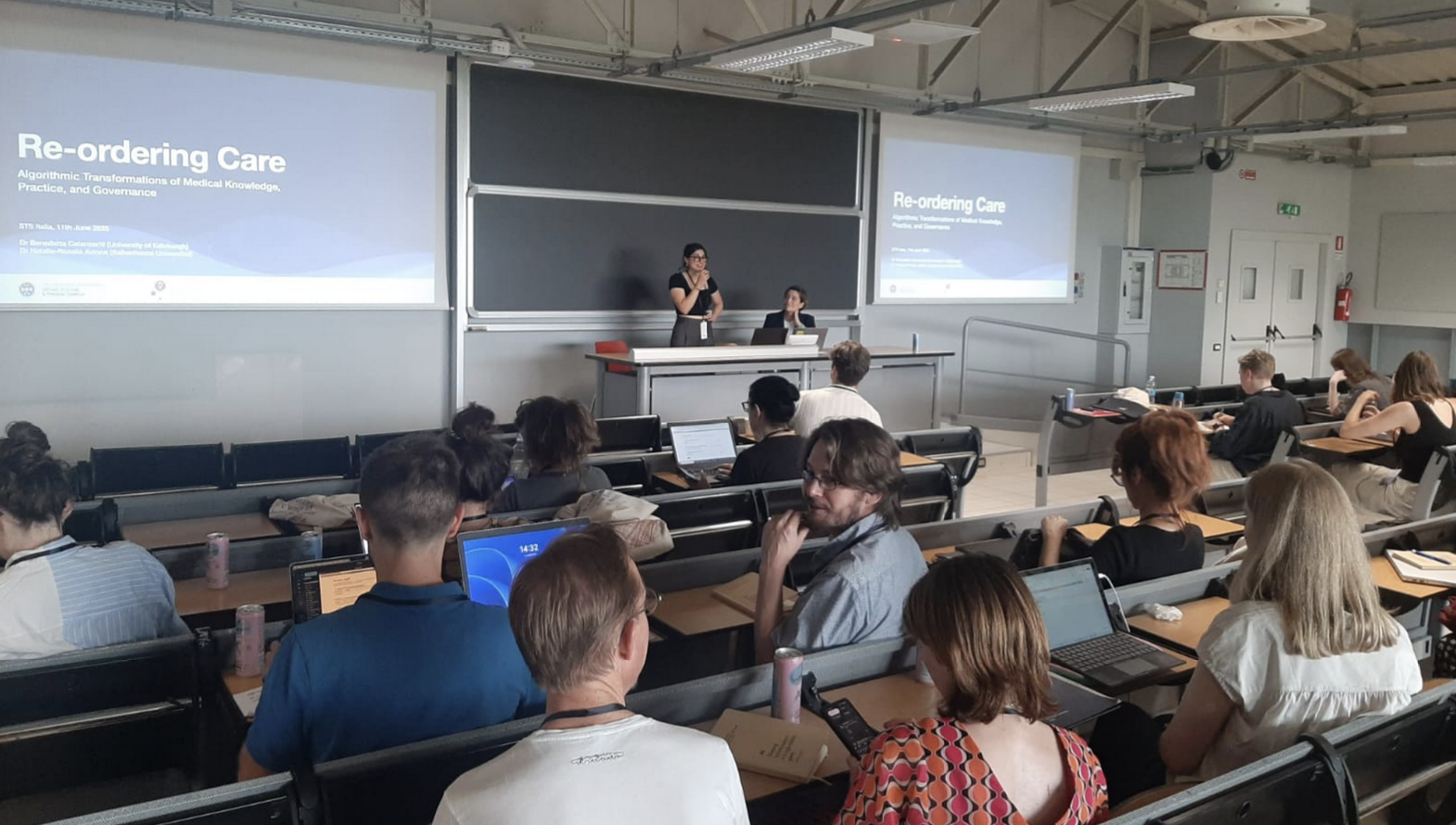
At this year’s 10th STS Italia conference in Milan, our panel, “Re-ordering Care: Algorithmic Transformations of Medical Knowledge, Practice, and Governance,” convened to critically interrogate the pervasive techno-optimist promises surrounding the development and use of algorithms in healthcare While proponents including tech organizations, health and research institutions, and policy makers celebrate algorithms for their potential to make healthcare faster, more accurate, and more efficient, such narratives frequently obscure the profound reconfigurations of knowledge, labor, and authority that lie in their wake. Our panel moved beyond the surface of these claims, shifting the analytical lens from viewing algorithms as neutral tools to understanding them as performative agents that actively participate in the remaking of medical worlds. The presentations collectively illustrated the varied and situated practices of care, and argued that the algorithmic transformation of healthcare is a complex and often contested re-ordering of care that demands careful and contextual scrutiny.
(Watercolor by artist and panelist Mai Hartmann, 2025)
Session 1: Human Frictions in Algorithmic Encounters
The first session brought together insights from five different case studies exploring the various entanglements of algorithmic systems with the moral, epistemic, and affective dimensions of health-care.
Jamie Webb opened with a thoughtful analysis of the UK's Transplant Benefit Score, an algorithm designed to allocate livers from donors after brain death, showing how its algorithmic complexity limits patient understanding and reduces clinician autonomy. Rather than calling for more trust in such systems, Webb argued for the value of ‘warranted mistrust’ as a tool for patient advocacy and systemic accountability. Tabea Ott then explored the impact of AI-driven smart sensor technologies on palliative care, warning that these tools risk reducing the richness of human experience to mere data points. Ott’s call to align technologies with the principle of Total Care, a palliative care framework addressing the physical, psychological, social, and spiritual dimensions of pain, and emphasized the importance of retaining autonomy, dignity, and a holistic understanding of care at the end of life. Turning to digital psychiatry, Katerina Sideri and Niels Van Dijk unpacked the epistemic tensions between clinical expertise, patient experience, and behavioural data in defining what counts as ‘mental’, ‘therapy,’ and the term/concept of ‘social’. Justien Dingelstad shared insights from the empirical investigation of a deep-learning algorithm designed to support multidisciplinary team diagnostic meetings for brain tumours. Ultimately, Dingelstad’s findings highlighted the gap between AI’s binary and simplistic logics and the collective, embodied nature of clinical decision-making. Finally, Mai Hartmann – aided by her beautiful watercolors – took us through the lived experience of patients with implantable cardioverter defibrillators (ICDs), showing how these shift responsibility from human caregivers to technicians and algorithmic systems, often creating new forms of emotional and informational asymmetry for patients and their families.
Session 2: The Algorithmic Production of Health: Remaking Norms, Patients, and Practices
The second session continued the critical conversation on how algorithmic systems might reshape healthcare—not just operationally, but normatively and epistemically. Across diverse case studies, the papers illustrated how data-driven technologies intervene in the production of clinical knowledge, redefining relationships of care and subtly rewiring what counts as health, risk, and expertise.
Catherine Montgomery offered an ethnographic look into critical care units and the parallel worlds of data science, where the promise that ‘data saves lives’ is shaping new clinical logics. As algorithmic risk prediction tools enter ICUs, she explored how embodied and relational forms of care are being reconfigured—raising questions about what care means in a system increasingly structured around real-time data streams and code. Abby King examined the creation of patient-centred metrics in remote clinical trials, revealing that such metrics do not capture patient experience but rather produce a particular version shaped by algorithmic affordances and institutional priorities. The translation of lived experience into quantifiable data becomes then a site of power, exclusion, and selective visibility. Eira Syvälähde focused on the Finnish Apotti Electronic Health Record (HER) system, where nurses grapple with the pressures of documenting care in structured formats designed for data extraction. Rather than supporting staff, Apotti intensifies workload and further fragments care. Nurses often resist full datafication, prioritising human presence and discretion over digital legibility. In the domain of elder homecare, Eliana Bergamin explored how data-driven tools – ranging from fall sensors to remote ‘empathy coaching’ – are reshaping how care is delivered, and who delivers it. Her ethnography revealed how deeply relational practices are being transformed into structured, time-bound interactions shaped by efficiency logics, with new actors and new forms of algorithmic authority emerging in the home. Lastly, Benedetta Catanzariti presented the preliminary findings from an investigation (co-authored with Sam Bennett, Alex Campolo, and Charlotte Högberg) of multimodal machine learning methods to forecast Alzheimer’s disease, showing how such models might generate new forms of medical normativity. Rather than detecting disease in traditional clinical terms, these systems probabilistically reframe risk and diagnosis by re-enacting disease across vastly different data modalities and contexts, and reassembling it into a single prognostic measure.
(Watercolor by artist and panelist Mai Hartmann, 2025)
Conclusion: From Frictions to Futures in Algorithmic Care
More than a collection of case studies, the panel collectively advanced a powerful argument: We must move beyond studying algorithms as tools that are simply ‘implemented’ in healthcare contexts, and understand them as performative agents that actively remake the worlds they enter. They do not just find disease, they generate new probabilistic ‘normativities’ that redefine risk and personhood. Algorithms do not just record experience, they produce the very ‘patient-centered metrics’ they purport to measure. This remaking of reality entails a profound re-ordering of epistemic authority, often enacting forms of epistemic injustice by design—from dissociations’ that systematically devalue patient testimony in digital psychiatry to informational asymmetries that turn patients into data conduits for systems they cannot read.
Furthermore, the panel made visible the invisible labor required to sustain these systems: the intensified data work of nurses, the new interpretive and emotional labor of patients and kin navigating their cyborg realities, and the fragmentation of relational work into commodified ‘empathy sessions’. Crucially, this re-ordering is not frictionless. The panel charted multiple sites of resistance, from the explicit call for ‘warranted mistrust’ as a tool for accountability to the tacit refusal of nurses to prioritize digital legibility over embodied presence—acts that simultaneously assert competing ‘logics of care’ and reveal the fragility of big data promises by compromising data quality. Lying behind claims of algorithmic precision, accuracy or efficiency is a flattening and misapprehension of complex, situated, and relational practices of care. Ultimately, the panel’s intervention is a call to action. If algorithms are performative and political, their design and governance demand more than technical validation, the critical task for STS scholarship is to actively shape these new sociotechnical imaginaries, ensuring the futures of care we build are not merely more efficient, but more equitable and just.
Author Bios Benedetta Catanzariti is a British Academy Postdoctoral Fellow in Science, Technology and Innovation Studies at the University of Edinburgh. Her research explores the social, historical, and political dimensions of data and AI, with particular attention to the ways computing cultures shape (and are shaped by) knowledge and society. Her current work investigates the contexts of development of medical AI, focusing on the tensions between, on the one hand, ambitions to scale up AI models across medical specialties and tasks and, on the other hand, practices and experiences that resist datafication and operationalisation. She is involved in several national and international research collaborations investigating the epistemic dimensions of data and AI and the material political economy of large computing infrastructures.
Natalia- Rozalia Avlona is a legal scholar and computer scientist whose work operates at the intersection of law, computer science, and the politics of care. Currently a Postdoctoral Researcher at the University of Copenhagen’s Department of Public Health (ERC DataSpace project), she recently completed her PhD as a Marie Skłodowska-Curie Fellow (DCODE network) in the Department of Computer Science at the University of Copenhagen. Her research moves beyond standard critiques of algorithmic bias to interrogate the infrastructural and labor conditions of AI production and governance. By framing data quality as “situated labor” and regulatory compliance as “invisible data work,”(Avlona, 2025), she exposes how high-level policy mandates (such as the EU AI Act) are negotiated, contested, and enacted on the ground by domain experts. A qualified lawyer (Athens Bar, 2008) with an LLM in Human Rights, she uniquely bridges the gap between aspirational regulatory frameworks and the lived realities of domain practice.