
Bri Matusovsky
01/05/2026 | Report-Backs
This blog post welcomes Bri Matusovsky as a new assistant editor to the 4S Backchannels Global North team.
This post is the first in a 4-part series on Sex and Gender in Primate Worlds, following up on a panel of the same name at the 4S 2025 convening in Seattle, Washington. The following post in the series will be released on January 19th.

A Historical Postcard from St. Kitts and Nevis. The image depicts a white woman lounging in a hammock on a beach.
Five green monkeys surround her. She is sharing pieces of cut-up fruit with the monkeys.
Introduction: Informed, Affirmative, and Affective Consent
Consent is often framed as a simple, binary choice: a clear "yes" or a definite "no." In scientific research and interpersonal relationships, our primary models—informed consent and affirmative consent—rely on the ideal of explicit verbal agreement. But what about situations where clear communication is not possible? What about contexts where there are power imbalances, where individuals do not share language, or which involve non-human animals? Based on my ethnographic research on human-animal relations on St. Kitts, I developed the theoretical framework “affective consent.” Affective consent describes the negotiations of nonverbal agreement and refusal within multi-species contexts, complex power dynamics, and situations where “yes” or “no” are not clear options.The Limits of Affirmative and Informed Consent
Affirmative consent arose from Western feminist political and legal advocacy in the 20th century and has transformed understandings of sexual and interpersonal relationships. This model offers the ideal of clear, knowing, and enthusiastic agreement for sexual activity. However, this framework has many limitations, given that financial, social, and physical dynamics are profoundly uneven.

This is a screenshot from Planned Parenthood's “Say Yes to Our Consent Partnership” webpage in October 2025.
The image defines affirmative consent in the context of human sexual relations using the acronym FRIES:
Freely Given, Reversible, Informed, Enthusiastic, Specific. A rendered drawing of potato fries is visible.
Informed consent is currently the gold standard for research. In this model, researchers are required to provide participants with information, like risks and benefits, so they can make voluntary decisions. Informed consent was formed in response to violent histories of human experimentation and research where participants were not historically informed of their participation. However, this framework falls short when it comes to animals, children, disabled people, or others who are unable to understand.
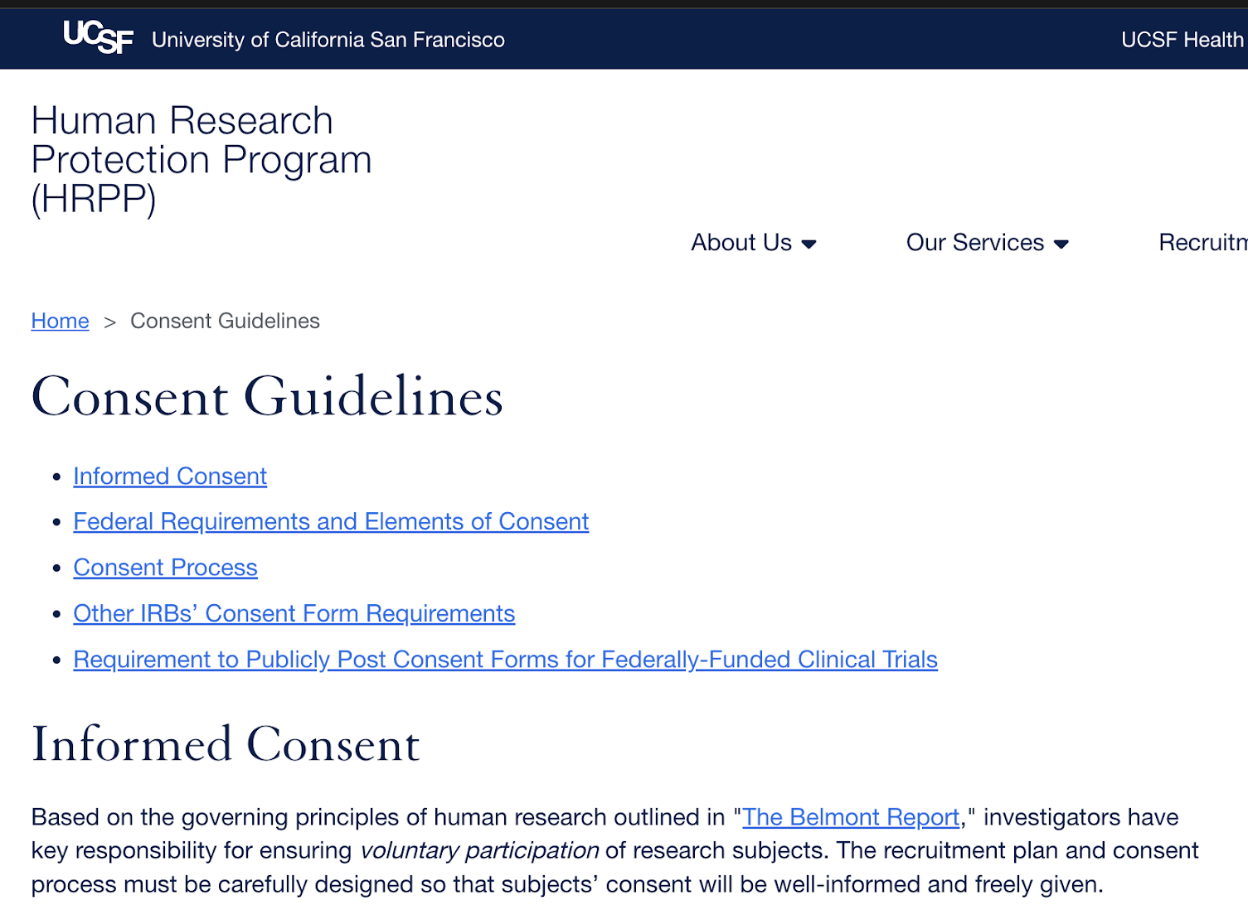
A screenshot of the University of California, San Francisco Human Research Protection Program (HRPP) website in October 2025.
The site links to federal requirements regarding informed consent.
The beginnings of a paragraph are visible, referencing the governing principles of human research outlined in The Belmont Report.
Some ethicists argue that animals can express dissent — a clear refusal to participate. The standard for care in Veterinary Medicine is currently informed consent by proxy, in which a human owner, veterinarian, or caretaker makes decisions on an animal's behalf. While this is well-intentioned, it's ethically fraught, as the proxy's own emotional and economic interests bias their judgment.
These models are crucial, but they are also not enough. They fail to account for non-consent experienced by animals or by people silenced in uneven power relations (for example, see J. Logan Smilges on silence as a generative and empowering mode of survival for queer and trans people). These models do not account for how people and animals communicate their desires and boundaries, even when they exist under conditions of limited autonomy or pervasive inequality.
Noticing (Non-)Consent During Multi-Species Ethnography
As a multi-species ethnographer, I observed affective consent in the microcosm of monkey research facilities on St. Kitts. Scientists and veterinary technicians face a significant challenge in finding monkeys who will peacefully cohabitate in group enclosures. This process involves people interpreting the negotiations between animals.
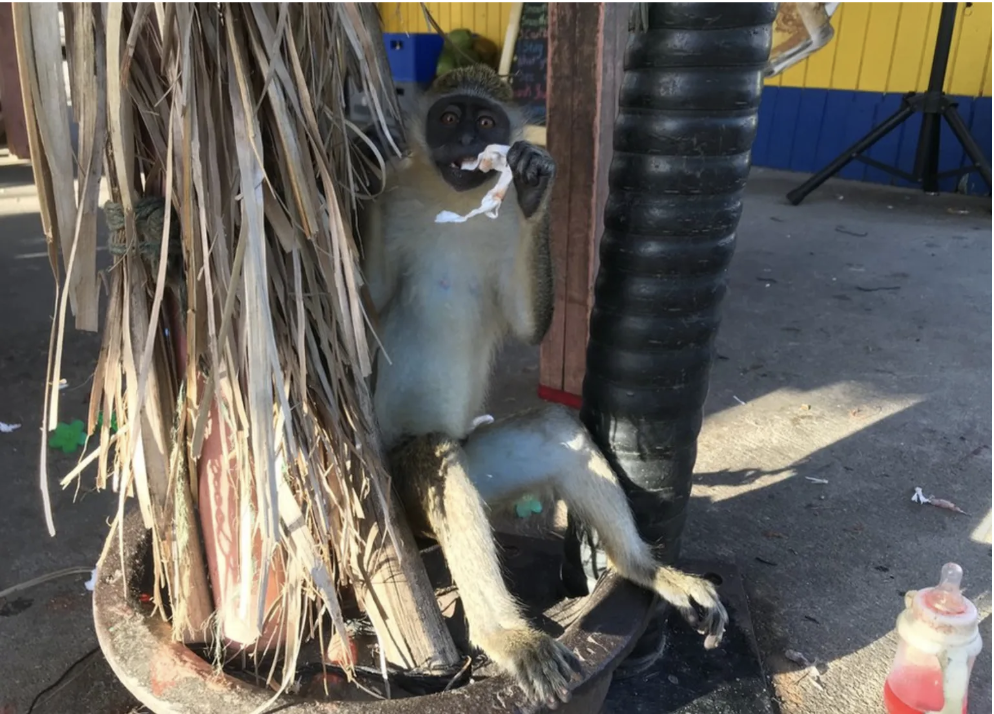
An image of a green monkey holding a piece of trash to its mouth. A small bottle meant for human babies lies on the ground not far from the monkey,
suggesting the monkey may be a pet. Bright blue and yellow-painted walls are visible in the background, and the ground appears to be concrete,
indicating that this photo was taken in an area where wild monkeys are unlikely to roam. This image comes from a BBC news article about green monkeys.
One veterinary technician I shadowed, a Black Kittitian woman named Layla, pointed out two monkeys, X937 and A613, who had been recently paired. X937 was a mother who had lost her baby and had stopped eating. A613 was a younger, smaller female who was being bullied by her previous housing unit. Layla explained, "X937 treats her like a daughter. She's gotten happier and started eating again. They groom each other." Grooming was an expression of affective consent—a nonverbal affirmation signaling these monkeys’ willingness to cohabit. Grooming among green monkeys is part of their hierarchical social structure—an expression of both trust and dominance.
Monkeys would express refusal through fighting, biting, or acts of exclusion, such as depriving another of food, as happened to A613 in her previous group. Layla pointed out that monkeys housed side by side but separated by a fence would "build animosity" and be more difficult to pair later. Layla’s insight was a learned part of her capacity to interpret affective (non-)consent amongst green monkeys in the artificial conditions of the research facility. This insight illustrates how the external environment shapes the conditions under which affective consent or refusal is possible.
Consent isn’t a single, precise moment. It's an ongoing process of negotiation. For laboratory technicians and veterinarians, interpreting affective consent necessarily involves continuous trial and error. It requires sustained attention to animals’ emotional and physical states. Scientists and technicians spent months cultivating this attunement as part of their training. They must learn to decipher a nonverbal lexicon of postures, sounds, and bodily cues to be effective in their roles. However, even at their best, researchers still made mistakes in this process. Interpreting affect is always an imperfect process.
Affect situated on St. Kitts
“Affect” in affective consent refers to the visceral, non-verbal bodily responses that carry the weight of history and circumstance. Interpreting affect involves the recognition and making sense of non-verbal cues – body language, sounds, and involuntary physical releases – as forms of communication. Affect is produced by local circumstances. Affective consent in laboratories in St. Kitts is different from that in the wild or elsewhere.

A screenshot of a BBC news headline article from August 2019, titled “Monkey Problem: St Kitts’ great attraction becomes great headache.”
Green monkeys are considered invaluable research subjects for scientists, but invasive pests for local farmers. People and green monkeys on St. Kitts suffer from food insecurity, a phenomenon locally known as “the monkey problem.” Scientists, veterinarians, policymakers, and primatologists have sought to address the monkey problem, which has escalated since the local abolition of sugar plantations in 2004, but have been unsuccessful. The monkeys' experiences of non-consent, whether in territorial disputes in the wild or in being rejected from a housing unit in a research facility, are affective expressions of these interwoven histories.
Back From Monkeys to Human Primates: The Broader Implications
The lessons of affective consent extend far beyond the laboratory. By recognizing that animals can and do experience non-consent, we are forced to acknowledge the limits of current frameworks. Considering affective consent challenges us to move beyond the verbal and explicit and to attune ourselves to the unspoken and embodied negotiations happening all around us. Affective consent offers a framework for seeing consent not as a transaction but as a dynamic, ongoing process fundamentally shaped by uneven power relations. Investigating instances of misinterpretation or disregard of verbal communication and affect can help clarify the mechanisms by which non-consent is reproduced in both animal care and human relations. Inquiry into affective (non-)consent, whether caused by a lack of training or education, personal attitudes, failures of interpretation, or cis-hetero-patriarchal conditioning, can allow for reparative opportunities, such as continuing education, to be conceived in new ways.
I hope this concept can act as a starting point. I invite readers to consider with me what it means to respect the desires and boundaries of others, whether they are human, animal, or something else entirely. I will explore the scholarly, political, and practical impacts of affective consent in further publications. In animal research bioethics, similar conversations are taking place. As I continue to refine this framework, I invite others to join the conversation.
Bri Matusovsky is an anthropologist whose work explores the ecological and multi-species legacies of plantation economies in the Caribbean. Their dissertation, "Primates and Plantation Futures: Unsettling Science, Race, and Consent on St. Kitts," examines how the afterlives of slavery, fantasies of scientific objectivity, and intertwined histories of speciesism, racism, and non-consent continue to affect both Kittitian people and green monkeys. You can find more of their work at www.matusovsky.org.
Published: 01/05/2026