Cultures of Platformization in Africa
Daivi Rodima-Taylor, Cathleen LeGrand, Chris Paterson, Winston Mano, Leah Komen, and Jörg Wiegratz
Edited by: Dipak Kr Chakraborty
04/20/2026 | Report-backs
Africa’s digital landscape is expanding rapidly, with platforms occupying an increasingly central role in economic and social life. Platforms shape how people communicate, work, access finance, and engage in public life — often filling gaps left by uneven infrastructures — while embedded in a complex mix of regulatory, financial, and cultural dynamics. Although frequently associated with innovation and connection, platforms also give rise to urgent
new risks and deepening inequalities.
Our symposium
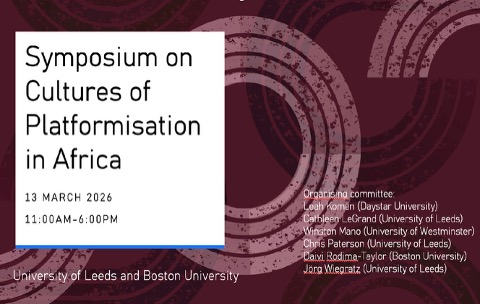
“Cultures of Platformization in Africa” brought together scholars from across Africa, the United Kingdom, and the United States, who examined platformization through a range of perspectives and empirical contexts. The all-day symposium took place on March 13, 2026, at the University of Leeds and online. The organizing committee included Chris Paterson (University of Leeds), Cathleen LeGrand (University of Leeds), Jörg Wiegratz (University of Leeds), Daivi Rodima-Taylor (Boston University), Leah Komen (Daystar University), and Winston Mano (University of Westminster).
Keynote speeches were delivered by Toussaint Nothias, who examined how researchers can respond to
digital colonialism through scholarship and public engagement, and Lusike Mukhongo, who addressed the ways to imagine more equitable digital futures through community-driven, participatory approaches and co-designed technologies. Chenayi Mutambasere’s lunchtime talk focused on emerging issues in the tech sector in Africa, exploring onshore data storage and "data poverty" in unserved rural communities.
The presentations of the first panel offered a nuanced view of
labor and entrepreneurship in the context of platformization. James Asande and Merci Gakii examined how digital platforms reshape urban space in Nairobi through livestreaming, introducing the idea of “virtual gentrification,” where urban environments are presented in ways that appeal to the aesthetic preferences of global platform audiences. Ewa Majczek and Gannty Ouangmotching discussed ride-hailing in Cameroon, showing how platforms like Yango interact with long-standing informal transport systems while also generating new tensions around labor, governance, and data. Rich Mallet explored Kampala’s moto-taxi sector, tracing how early expectations of formalization and improved working conditions have evolved, alongside emerging challenges and uneven outcomes for workers. Sophia Rabie focused on migrant food delivery riders in Cape Town, situating platform work in broader conditions of precarity and mobility, and showing how workers build livelihoods and make sense of their participation. The panel discussed how platforms intersect with urban space, informal economies, and migration, and highlighted the importance of local agency, showing how workers and urban actors actively adapt to and negotiate platform logics.
The second panel highlighted how platformization is deeply entangled with questions of gender, vulnerability, and resilience. Emmanuel Tembo examined the mental health challenges faced by digital content creators in Zimbabwe, showing how audience expectations and economic pressures intersect with local moral frameworks. Tumelo Mokoena and Seriane Morapeli explored online gambling in South Africa, analyzing how platform advertising shapes youth perceptions and how design features can obscure risks, raising concerns for regulation and public health. Scheherazade Safla studied platformized storytelling among young women in South Africa’s Cape Flats, focusing on how digital media can both enable and constrain forms of self-representation. Chiadikaobi Ihuoma examined feminist discourse in Nigeria, analyzing how different platform architectures shape the expression and circulation of feminist ideas, and how visibility and aesthetics influence the forms activism can take. The papers showed how platforms shape not only opportunities for expression and participation, but also new forms of risk and inequality, and foregrounded how individuals and communities navigate these conditions in creative and strategic ways.
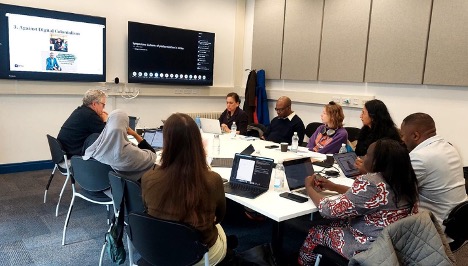 Participants collaborate during the symposium (University of Leeds). [Image credit:Jorg Wiegratz]
The third panel highlighted the central role of
social media in shaping how platforms are understood, imagined, and used. Samuel Uwem Umoh discussed how social media shapes migration aspirations in Nigeria through the “Japa” discourse, in which influencers construct idealized visions of life abroad while often downplaying risks and challenges. Victoria Mtomba explored how the users of Facebook Marketplace in Zimbabwe adapt the platform to local economic conditions, creating hybrid online–offline trading systems grounded in cash transactions and informal trust mechanisms. Rosemary Nyaole-Kowuor examined “digital hustle” narratives in Kenya, showing how social media serves as a space in which platform participation is explained and moralized through everyday communication about work, success, and self-improvement. Simidele Dosekun explored financial influencing in Nigeria, showing how social media and fintech platforms shape new forms of investor identity, encouraging participation in global markets while reinforcing existing hierarchies. The panel demonstrated that platformization operates not only through infrastructures and markets, but also through narratives and everyday communicative practices. It showed how users actively interpret and adapt platform logics, while also revealing how these processes can reproduce broader inequalities.
Panel Four highlighted how platformization is shaped by
policy decisions, institutional contexts, and varied forms of resistance. Philip Mong’are Achoki examined AI platformization in Africa, analyzing how digital skills platforms reorganize labor, expertise, and subjectivity, while also highlighting how workers navigate these systems through informal learning networks and collective practices. Toussaint Nothias explored legal challenges against global technology companies in Kenya, situating them within longer histories of digital rights advocacy and showing how they emerge as efforts to contest platform power and digital colonialism. Rhona Nabutto and Fred Kakooza discussed platform use in Uganda’s public sector during the COVID-19 lockdown, showing how digital tools enabled continuity while also reproducing existing institutional hierarchies. Suzanne Temwa Gondwe Harris analyzed charitable activity on TikTok, where platform logics can reproduce racialized humanitarian narratives and commodify suffering within global attention economies. Lastly, Jonathan Greenacre examined the uneven diffusion of mobile money across African countries, showing how regulatory choices played a decisive role in shaping platform growth and market outcomes. The papers of the panel emphasized that platform power is neither fixed nor uncontested, but continuously negotiated across different sites. The panel foregrounded the political and institutional dynamics through which platforms are governed, challenged, and reworked in African contexts.
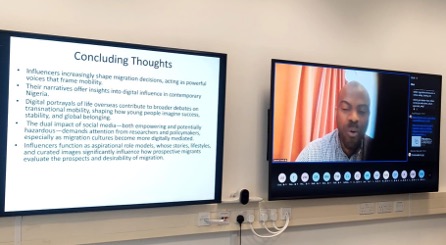 A virtual presentation in progress as Samuel Uwem Umoh shares insights on social media content creators and migration in Nigeria
[Image credit: Jorg Wiegratz]
The discussions highlighted platformization as an uneven and contested process shaped by the interaction between global systems and locally grounded practices. Platforms interact with long-standing informal economies and systems of trust, producing new hybrid arrangements and eliciting new forms of agency. By grounding the study of platforms in everyday experiences and narratives, the symposium contributed to a cultural perspective on platformization. It emphasized the lived realities of precarity, vulnerability, and resistance that shape how platforms are understood and experienced across Africa.
Ultimately, the presentations pointed to the importance of recognizing local knowledge systems and community-based practices as central to how digital technologies are designed and sustained. They highlighted the need to move beyond extractive models of platform development and to rethink platform technologies in Africa as participatory and locally grounded. Importantly, the symposium invited a reconsideration of the role of researchers as publicly engaged actors who contribute not only to academic debates but also to wider discussions around governance, ethics, and the social implications of digital technologies.
For details about the symposium, its participants, and the extended abstracts, click here.
Daivi Rodima-Taylor is Researcher and Lecturer at the Pardee School of Global Studies of Boston University, focusing on human economies, Fintech and inclusion, and diaspora studies.
Cathleen LeGrand is Leeds Arts and Humanities Research Visiting Postdoctoral Fellow, specialized in information equity, libraries, digital divide, and Open Research.
Chris Paterson is Professor of Global Communication at University of Leeds. His research focuses on international journalism and international communications.
Winston Mano is Professor at Westminster School of Media and Communication. His research focuses on Afrokology, Decoloniality, and new media and democracy.
Leah Komen is Senior Lecturer at Daystar University in Kenya. She specializes in development communication, with a focus on mobile media, ICT for Development, and social and behavioral change communication.
Jörg Wiegratz is Associate Professor of Global Political Economy and Development at University of Leeds, whose research explores neoliberalism, market society, neoliberal/capitalist moral economy & moral restructuring, and economic fraud.
Published: 04/20/2026
