
Documenting Procedural Injustice: Archival Tactics
In this blog post, we share an overview of our paper, “Documenting Environmental Procedural Injustice: Archival Tactics,” developed for a panel for the 4S Annual meeting (2026) entitled: “Parsing Environmental Procedural Injustice: A Call for Collaboration.” The panel, organized by Kim Fortun, brought together STS scholars and anthropologists to examine how procedural exclusions take shape in different institutional contexts, and how those exclusions produce durable forms of procedural injustice–that is, decision-making processes that exclude certain groups from defining and addressing problems (Bell and Carrick 2017). Our paper sought to contribute to conceptualization of procedural injustice as a condition that demands new research practices, particularly archival ones. Our contribution to the panel focused on two questions: first, how procedural injustice is enacted across our field sites in Louisiana; and second, how scholars might respond methodologically to the exclusions they encounter in their research.
In examining procedural injustice, this paper builds on a broader collaborative effort to make procedural exclusions more visible under the umbrella of the Environmental Governance Global Record, a digital knowledge commons hosted on the Disaster STS Network that links scholars and communities working toward environmental justice through collaborative ethnography, archiving, and teaching. This paper responds to broader STS questions around the democratization of scientific knowledge production and the civic data practices through which communities seek to make knowledge actionable (Lehtiniemi and Ruckenstein 2018; Fortun et al. 2021), particularly in the face of epistemic injustice (Fricker 2007).
Data Divergence and Sacrifice in Louisiana
Our shared research has focused on “Cancer Alley,” an 85-mile industrial corridor between Baton Rouge and New Orleans. Here, where 25% of US petrochemical products are processed (Health on Call 2025), residents face extremely high levels of air pollution and a range of health impacts. Through our fieldwork in Louisiana, we’ve both observed that official data and documentation often fail to capture residents’ lived experiences of environmental harm. This failure is rarely accidental. Governing agencies frequently overlook—or actively erase—the links between health outcomes, environmental hazards, and structural racism. Agencies do this to reduce liability for racialized siting of petrochemical plants, delay regulatory action, and stabilize the extractive economic system. These dynamics are enabled by what we refer to as data divergence, that is, inconsistencies within or between datasets, or gaps between the data and the social realities they claim to capture (Srigyan and Fortun 2025).
For example, Louisiana state agencies explicitly denied the existence of Cancer Alley (Allen 2003), despite residents’ own observations and robust data documenting higher than average cancer rates in the petrochemical corridor between Baton Rouge and New Orleans (Terrell and Julien 2022). The faith-based group RISE St. James, for instance, works to remember the people whose deaths are tied to poor environmental conditions—emphasizing that “Cancer Alley is real” (Watson 2026). And yet, the parish-level focus on health outcomes that state agencies once took obscured connections between cancer rates and proximity to petrochemical sites. Disparities in cancer incidence are often only visible at a census tract level (Krieger 2006). Thus, agencies’ longstanding refusal to release census tract data–until very recently–made it easier to deny Cancer Alley’s disproportionate health burden. Such denials make it difficult to trace patterns of harm tied to industrial exposure or historical disadvantage, and they narrow the evidentiary basis for policymaking, reinforcing procedural exclusions by limiting what counts as actionable knowledge.
During a joint fieldwork trip to Louisiana, we learned that members of RISE St. James were in the process of developing a set of surveys to study health impacts in their community, but also to articulate new visions for economic development of the region. Generating this knowledge can be read as a refusal of what theologian Ryan Juskus calls false sacrifice: political–economic orders that render communities expendable as “sacrifice zones” (Juskus 2024). In contrast, Juskus defines true sacrifice as practices that “make sacred” damaged lives and places by insisting on their value, care, and protection rather than their disposability. Importantly, these practices don’t just challenge fossil-fuel sacrifice zones, but also guard against their renewal as “green sacrifice zones,” where supposedly clean and sustainable projects still shift environmental costs onto other people’s communities. For RISE, the cost of producing knowledge about environmental harm in the community is itself a sacrifice—people have lost their friends, families, and lives due to environmental harms and related health outcomes.
Here, in Louisiana, memory work—that is, practices that take place in informal and formal spaces (Caswell 2021)—becomes a way of honoring losses and refusing demands for further sacrifice, and thus “making sacred” the community of St. James. In seeking to support RISE’s ongoing efforts, our conversation turned toward the kinds of knowledge infrastructures that we, as researchers, might collaboratively design–resources that could sustain memory work and connect it more deliberately to teaching and pedagogy.
What follows is a description of the project that emerged from these discussions: a university-based archival and educational project designed to not only document advocates’ memory work, but to activate understanding of, and engagement with, environmental justice and the politics of knowledge production. In this way, we respond methodologically to the exclusions encountered in our research by archiving examples of procedural injustice and advocates’ resistance to these exclusions; and by creating pedagogical materials to guide thoughtful and practical engagement with the archive.
Archiving and Teaching Procedural Injustice in Louisiana
Focusing on Louisiana, Fisher has worked with Lavigne, Schütz, and other collaborators to develop an open educational resource grounded in ethnographic case materials. These materials include ethnographic vignettes, photo essays, slide decks, photographs, and interview recordings and transcripts. These case materials demonstrate the diverse ways ethnographic data can be used to illustrate environmental harms. A final collection juxtaposes photographs with an ethnographic vignette that describes a community tour led by Sharon Lavigne. This collection illustrates how memory work can help fill data gaps, build relationships, and offer inspiration for advocacy. It serves as a key resource for the remaining lesson plans, which guide students in contributing to projects of epistemic maintenance and repair. In this way, the collections serve as both educational tools and archival counters to the evidentiary gaps in state records.
Figure 1. Collective memory work as care in St. James Parish
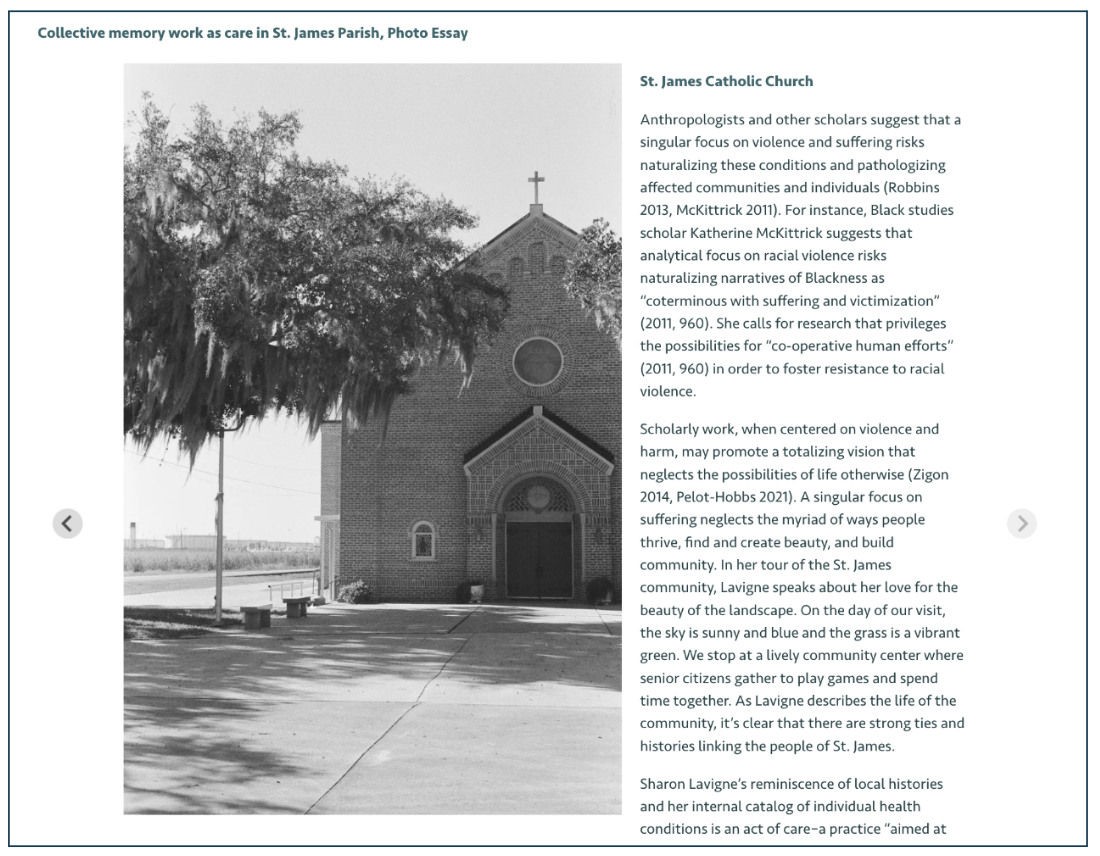
While the archival materials can be explored in diverse ways, the lesson plans offer a roadmap for engaging with them. The first lesson plan establishes a conceptual foundation, inviting students to work with core concepts (e.g. procedural injustice, data divergence) by identifying examples across case materials. Some concepts are explicitly named; others are left open to interpretation, encouraging students to develop analytic capacity by constructing definitions grounded in empirical evidence.
The second lesson plan focuses on the creation of corollary records, drawing on scholarship that challenges Western colonial traditions of archiving. Information and library studies scholar Elliot Kuecker and their colleagues (2024) emphasize feminist pedagogical approaches that recognize personal histories as theoretically meaningful, while archivist Michelle Caswell (2014) advocates for bottom-up archival practices that treat participants as experts in their own experiences. Building on this work, the lesson plan invites students to reflect critically on the risks and responsibilities of archiving.
The final lesson plan guides students through conducting ethnographic interviews. Working collaboratively, students produce interview instruments, recordings, transcripts, and analysis that add to the archive they have been working with throughout the course. Community leaders and advocates–from Louisiana, and elsewhere–are invited to contribute to the archival collection through interviews conducted by students. The ultimate goal is for all participants in the class—students and advocates alike—to be empowered to engage critically in identifying and responding to the procedural injustices that compound environmental harms.
Conclusion
In this paper, we have shared how our ethnographic engagements in Louisiana offer new perspectives on procedural injustice, both as an object of research and an orientation that demands new research and archival practices. Data divergences create a narrow evidentiary field for addressing the environmental harms experienced by residents of Cancer Alley. They reinforce procedural injustice by limiting residents’ capacities to engage meaningfully in decision-making. Moreover, these exclusions contribute to configuring Cancer Alley as a “sacrifice zone,” an arrangement that residents actively resist through informal and formal forms of memory work. We suggest, in response to these conditions, that scholars can play an active role in countering procedural injustice by not simply documenting exclusions and resistance, but deliberatively linking advocacy and educational contexts in mutually supportive ways.
______________________________________________________________________________
Margaux Fisher (margauxf@uci.edu) is a doctoral candidate in the Department of Anthropology at the University of California, Irvine, and a member of EcoGovLab, a collaborative focused on interdisciplinary environmental research and education. Her research focuses on how practices of knowledge production shape public health policy, and how stakeholders collaborate to confront structural inequalities as central determinants of human health.
Tim Schütz (tschuetz@uci.edu) is an independent researcher with the EcoGovLab at University of California, Irvine. His research focuses on the role of data and knowledge infrastructure in environmental governance and movements, with an emphasis on civic and ethnographic archiving practices. Starting in summer 2026, he will be a Marie Skłodowska-Curie postdoctoral researcher at the Center for Climate IT at the IT University of Copenhagen.
Edited by Gina Hakim
Published: 04/27/2026