STS, here and now: Reflections on ST&HV School 2026 in Seoul, South Korea
강미량 Miryang Kang | Korea Advanced Institute of Science & Technology - KAIST
Edited by: Jo Yi Lim
10/06/2026 | Report-backs
In June 2026, a four-day “STS School” took place in Seoul, South Korea. Organized by the
Science, Technology, & Human Values (ST&HV) editorial collective and hosted by
Seoul National University and
Korea Advanced Institute of Science and Technology, the school brought together 10 instructors and 36 early-career scholars from Korea, Japan, India, Vietnam, Singapore, New Zealand, Australia, and the U.S. A key element of the school was the opportunity for early-career participants to share their research. Each participant had a full 30 minutes to present their research and receive feedback, and all were assigned an instructor for mentoring. As one of the participants, I also enjoyed the opportunity to share part of my doctoral research and receive in-depth comments.
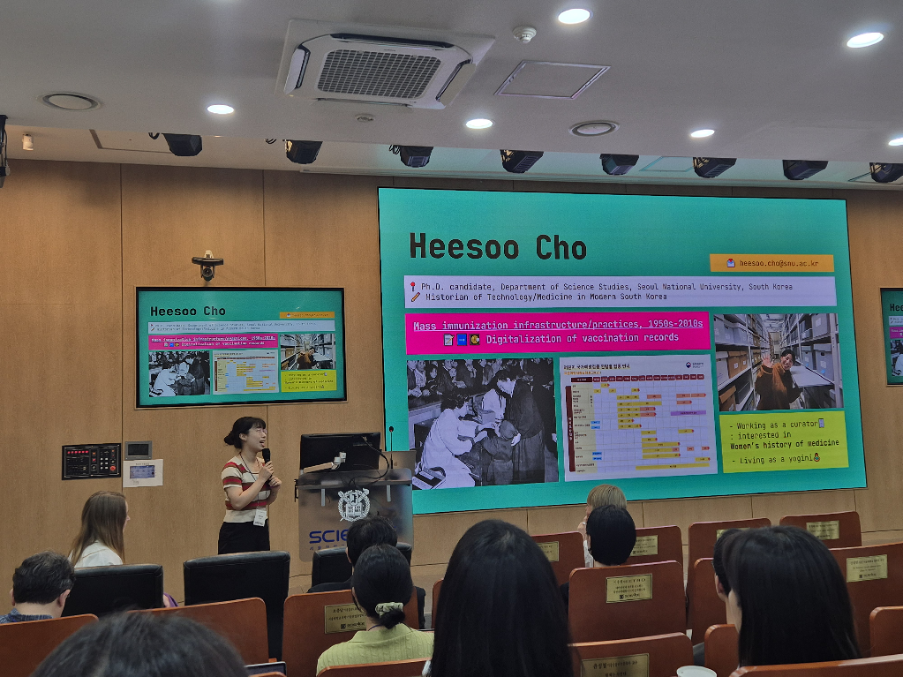
Figure 1. The school began with brief introductions by the participants, June 22, 2026. Heesoo Cho, Ph.D. candidate in the Department of Science Studies at Seoul National University, introduces her dissertation project on the history of mass immunization in South Korea. [Image credit: Miryang Kang ]
The school was a lively meeting ground for scholars with diverse backgrounds and motivations. While a few had trained in Science and Technology Studies (STS) departments, most came “sideways” from other fields, such as history, anthropology, sociology, geography, area studies, public policy, and international relations. Thus, the ways we chose topics, asked questions, and put them into words were highly heterogeneous. As researchers, we followed different entities in different times, spaces, and scales. Laboratory instruments, reproductive technologies, computers, cosmetics, disabilities , disasters, Attention-Deficit/Hyperactivity Disorder (ADHD), data, rice paddies, toxins, robots, do-it-yourself (DIY) hormones, transmedicine, the COVID-19 pandemic, semiconductors, and vaccines, past and present, in Asia and elsewhere, all formed the objects of our STS inquiries. We attached different stakes to our inquiries. Care, justice, innovation, remediation, personhood, sovereignty, domesticity, feminist politics, transnational science, maintenance, and so on. This diversity set the stage for a lingering question that stayed with us during the school: What is STS?
The field trip on the second day offered productive sites for exploring this question. Three visits were arranged so that we could learn about different amalgamations of things and beings that compose Seoul as a society. We walked along the Cheonggyecheon stream, listening not only to the sound of flowing water but also to the stream’s contested history. The stream was restored through a massive engineering project that instigated debates about what
authentic restoration would be.
1 We were guided by an urban studies researcher, Dr. Eunseon Park, through the Cheonggyecheon machine shop district, where we met technicians and engineers who had long supported the Korean engineering industry through their remarkable skills but now faced threats of displacement under the city’s “redevelopment” project. At the National Museum of Korean Contemporary History, Dr. Seong-jun Kim , a historian of science, prompted us to look at how the history of Korean industrialization, development, and democracy has been written and what materials have been used to write it. These intensive field visits inspired us to think about STS with a concrete sense of place in mind. What does it mean to do STS from
here and from
now?
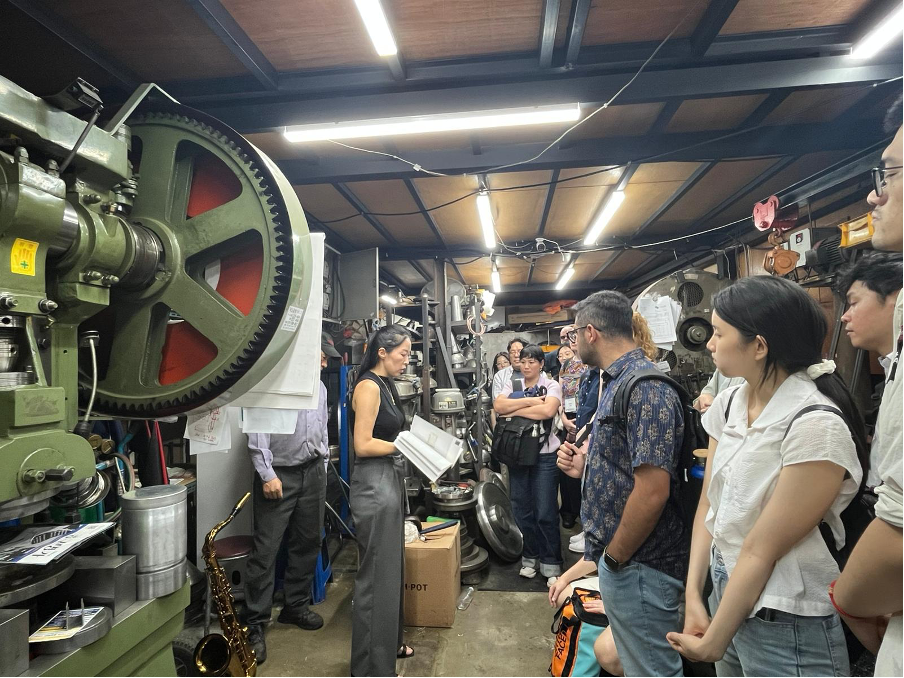
Figure 2. Guided Tour of the Cheonggyecheon Machine Shop District, June 23, 2026. Eunseon Park, an urban studies researcher, activist, and director of Listen to the City,2 is explaining the work of a machine shop and the possible loss of tacit knowledge that could result from the district’s planned “redevelopment.” [Image credit: Heesoo Cho]
The “here” in this question could extend to many places that participants brought to the school. It could be one’s home country, home institution, field site, or main archive. The politics of this question lies in foregrounding where we found ourselves as the locus of STS knowledge production, rather than treating it as just another case for validating existing concepts. As a mode of engagement, the ST&HV editorial collective suggested the metaphor of “conversation”: to do STS means to be in conversation with STS. This metaphor offered a useful guide on how to engage with STS literature and formulate our contributions to it. It also reflected the editorial collective’s commitment to decentering Euro-American ways of thinking and attending to what the school participants care about.
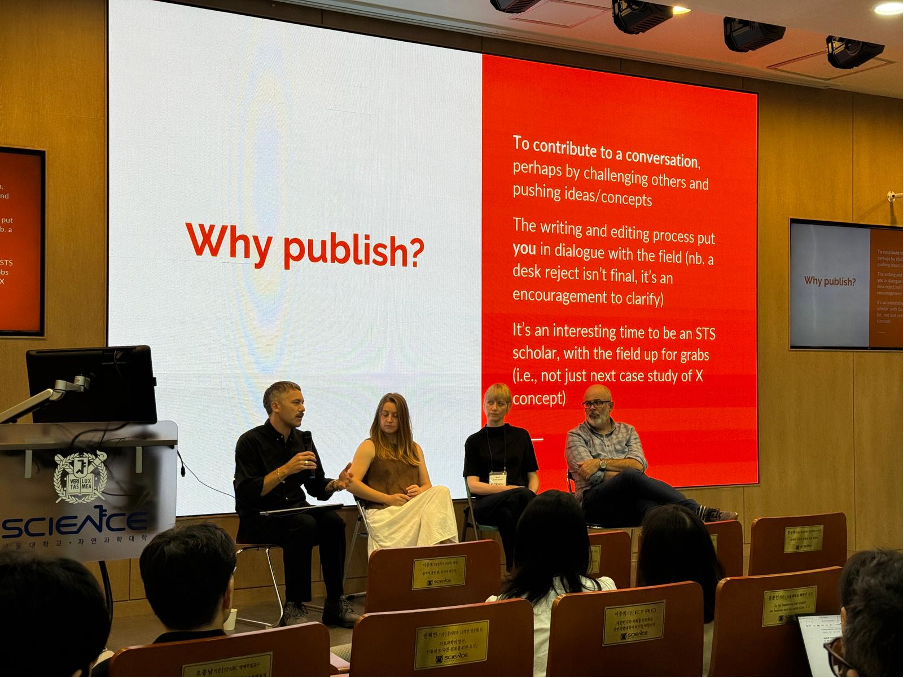 Figure 3. The ST&HV editorial collective’s session on June 25, 2026. [Image credit: Heesun Shin]
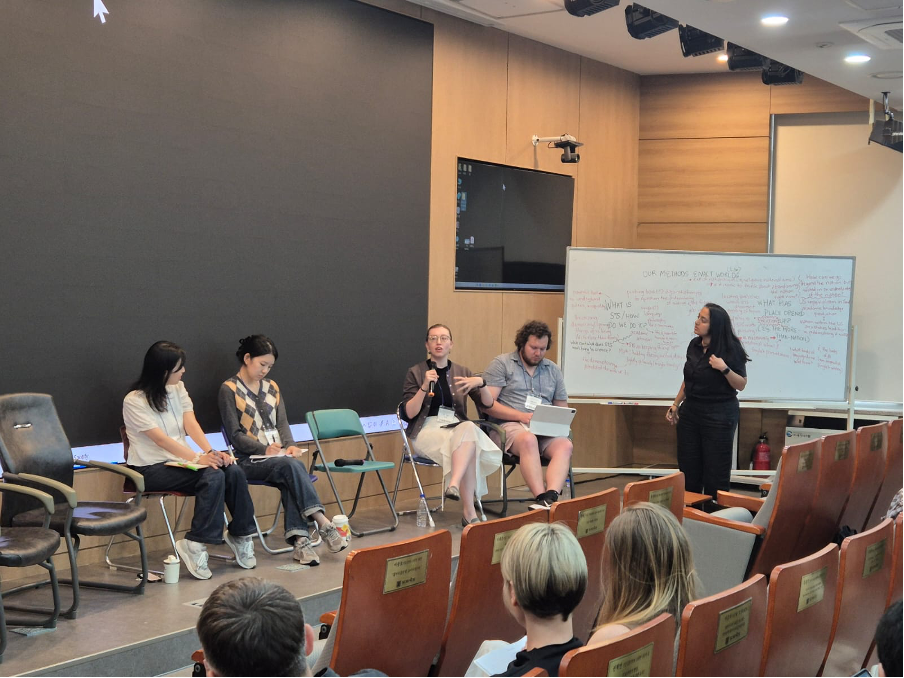
My interpretation of being in conversation with STS is to ponder and articulate what we dream of STS becoming through our presence in it. This interpretation reflects how school participants came to build an STS community across different languages and cultures. On the first day, participants sat clustered in groups with those they already knew. Asian students whose first language was not English didn’t speak much during feedback sessions, and some presenters felt that their presentations were like dissertation defenses. It was clear that we were nervous—the pressure to speak English flawlessly and the tension between different cultures of critique filled the room.
The organizers quickly picked up on this atmosphere and worked to make the school a safe space for learning and community-building. During the morning sessions on the second day, I sensed a different mood. Mentors slowed down their English. Moderators guided the audience to focus on what each presenter aimed to achieve, rather than on what was missing in the paper. As time went on, I noticed that the way we exchanged feedback was changing. Participants talked more about what stood out to them in one another’s research and offered concrete suggestions. The tone became more generous and collaborative. We were learning to show curiosity with care.
Scholars based in Asia too often find themselves subject to easy judgments about whether their STS is STS enough. We hear that we are not familiar with specific genealogies of the field, our findings are too culturally specific and difficult to understand, and our English needs polishing. Constantly receiving these comments makes us anxious and nudges us to turn to the field’s authorities. Of course, the school was not free from this dynamic. Many papers, including mine, drew primarily on Euro-American scholars and theorists rather than on Asian scholars. But school participants also crafted an ethics of orienting toward scholars coming from around the world. This orientation brought our stories into mutual conversations. It made us colleagues. Our STS emerges here and now as we share the joys and struggles of doing STS from multiple worlds.
notes
Miryang Kang is a Ph.D. candidate at the Graduate School of Science and Technology Policy, Korea Advanced Institute of Science and Technology. Working at the intersection of science and technology studies, medical anthropology, and disability studies, she examines how technologies shape ideas about human capacities. She is currently completing her dissertation on rehabilitation robotics in South Korea.
Published: 10/06/2026