Location, Location, Location: Laboratory Politics in Late 20th Century Simian Psychology and Linguistics
This post is the second in a 4-part series on “Sex and Gender in Primate Worlds,” following up on a panel of the same name at the 4S 2025 convening in Seattle, Washington, held on September 6th, 2025. The following post in the series will be released on February 2nd, 2026.
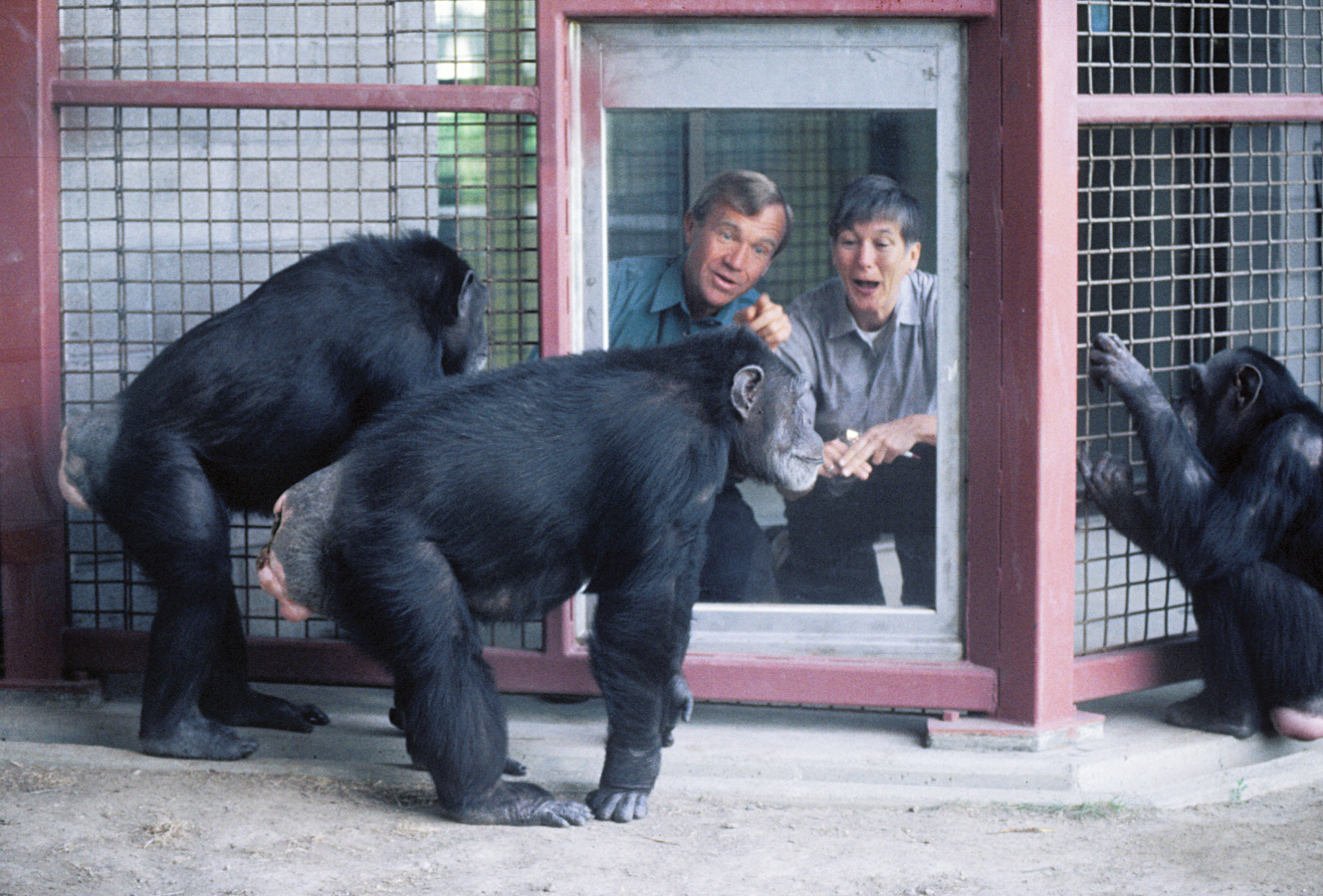
Two researchers, Deborah and Roger Fouts, and three chimpanzees in a research enclosure at Central Washington University (CWU)
Chimpanzee and Human Communication Institute (CHCI) [1993-2013]. Image courtesy of Central Washington University.
Laboratories are hot real estate. It’s one thing to concoct an experimental procedure; it’s quite another to have a room of one’s own to see it through. Experiments that require plots of land for unique purposes seek funding to build and sustain sites of scientific work, competing for space. For studies of non-human primates, whether psychological, linguistic, or biomedical, the spatial problem is particularly fraught: simians have specific needs — nutritional, emotional, even sexual — that necessitate careful, planned consideration. How the limited number of possible sites in a given location—a university or a large, private lab, usually — are divvied up involves politicking and tough choices.
The panel “Sex and Gender in Primate Worlds” at the 2025 Annual Meeting of the Society for Social Studies of Science explored this issue. Within a larger study on the language of consent around Green Monkeys on St. Kitts Island,
Bri Matusovsky’s presentation highlighted the different physical types of enclosures and materials used to house Green Monkeys at primate research facilities on St. Kitts in the Caribbean.
Lilith Frakes – on the epistemic status of hybrid primates – and
Quinn Georgic – on lemur behavioral patterns – asked us to confront questions of who gets to be a primatologist, the racialized politics of the scientist’s gaze, and, thus, where primatological work is done.
Brigid Prial traced how psychologists, primatologists, and medical researchers thought through and defined the concept of a “self-sustaining” laboratory primate colony as a specific kind of experimental space. Even as these projects centered on questions of sex and gender, they were all situated within questions of laboratory spatial politics. We can only be where we are.
In studies of non-human ape language acquisition — my research area — the location question was ever-present. From approximately 1965 to 1980, and largely as a product of American Cold War scientific interest in uncovering a universal biological grounding for human nature, “
Ape language experiments” probed the nature-nurture and nature-culture divides by attempting to teach chimpanzees and gorillas human signed languages and other symbolic communication systems. These studies were the talk of the town: featured on
television, in
documentary films, and in print media ranging from
The New Yorker to in-flight magazines. Ape language researchers tapped into a postwar, Cold War, Big Science funding free-for-all in the United States—encompassing the National Science Foundation, the National Institute of Mental Health, the William T. Grant Foundation, and the National Geographic Society, to name but a few major players — and received generous funding, well into the millions of dollars.
Ape language psychologists constructed an impressive array of cross-country experimental facilities. In Reno, R. Allen and Beatrix Gardner continuously converted their large ranch-style property into an archipelago of chimpanzee housing units and testing rooms. Further north, the Gardners’ former student, Roger Fouts, lobbied the Washington state government to help fund a state-of-the-art complex for Washoe and her adopted chimpanzee family — Dar, Tatu, Moja, and Loulis — at Central Washington University in the early 1990s. Outside Philadelphia, David Premack of the University of Pennsylvania retrofitted his university’s Honeybrook Farms medical research facility for Sarah, a chimpanzee who learned a symbolic communication system of magnetic plastic tokens. Down in Atlanta, Duane Rumbaugh carved out his own slice of experimental heaven within the Yerkes Regional Primate Center to teach the chimpanzee Lana the lexigram system “Yerkish.” In the Bronx, Herbert Terrace installed Nim Chimpsky in the Columbia University-owned Delafield Mansion and paid the university rent with research funds. Studies on the language-learning capacity of great apes thrived due to their locations — off-campus, idiosyncratically adaptable — as much as their in-laboratory practices.
Limited space for ape sign work meant competition with other simian sciences – competition which was resolved, in at least one instance, through competing ideas of important primate procreation. At Stanford University in the early 1970s, Psychology graduate student Francine “Penny” Patterson, in collaboration with Stanford administrators, moved the gorilla Koko from the San Francisco Zoo down the peninsula to a trailer on campus. On-campus ape housing was, as we see through comparison with the studies outlined above, an exception, not the rule; as Koko grew bigger and stronger, administrators worried about her ability to potentially harm students. Patterson was forced, by the same administrators who had once been her steadfast allies, to look for a new home-lab location combination.
She did not have to look far. In 1974, the School of Medicine opened the Stanford Outdoor Primate Facility (SOPF) under the leadership of Professor David Hamburg and famed research scientist Jane Goodall. The Facility conducted normal operations for less than a year; in the early summer of 1975, students researching at Goodall’s Gombe Stream site were kidnapped by insurgent revolutionaries and held for ransom. All were eventually released, though not without fallout: Goodall’s relationship with the university was terminated, and Hamburg left for greener pastures. With SOPF’s raison d’etre eliminated, a space was made (literally) for Koko and her gorilla playmate, Michael, to live and work at Stanford. Though Patterson and her advisors lobbied administrators for exclusive use of SOPF beginning in 1977, they remained unconvinced: why use such a large ground, they reasoned, for two gorillas who, if lucky, might procreate once, when, instead, the facility could become a rhesus macaque breeding hub. That the study of intergenerational sign language among gorillas required only one instance was not of interest: SOPF had become a numbers game in which macaque volume held sway. By 1979, Patterson and her gorillas had left campus for Woodside, California, having lost the struggle for space.
Non-human primate facilities offer a unique window into the politics of space and sex in experimental science. Decisions over the apportionment of scarce resources are often made for reasons that appear alien to the best or most potentially novel experiment–at Stanford in the late 1970s, the School of Medicine had authority over the Department of Psychology. It defined experimental productivity not in terms of potential novelty but as mass reproduction. Studies are enmeshed in much larger networks: of funding, of shipping, even of regime change. The place for primate studies, this work suggests, has been away from prying eyes, when and where nobody’s looking.
______________________________________________________________________________
Max Fennell-Chametzky is a PhD candidate in the History Department at Stanford University. His in-progress dissertation, “Primate Verbalizations: Ape Language Experiments and the Global Remaking of the Human, 1930-2018,” is a cultural and intellectual history of the ape language era in and beyond American behavioral, human, and evolutionary science.
Edited by Bri Matusovsky
Published: 01/19/2026